Best Portable Air Conditioner for Motorhome: Stay Cool on Your Adventures
Traveling in a motorhome delivers unmatched freedom, but extreme heat can quickly turn a dream trip into an uncomfortable experience. A reliable portable air conditioner for motorhome use has become an essential upgrade for travelers who refuse to sacrifice comfort on the road. Unlike permanent rooftop units that demand professional installation and extensive vehicle modifications, portable cooling solutions provide flexibility, affordability, and straightforward operation.
These compact systems can be relocated between different areas of your coach, stored out of sight when not in use, and even deployed in tents, cabins, or campervans. The market has matured rapidly, with manufacturers engineering highly efficient models tailored to the unique demands of mobile living. By evaluating your cooling needs, electrical capabilities, and available interior space, you can select the ideal portable air conditioning setup for your journeys.
Understanding Portable Cooling Options for Motorhomes
The portable cooling landscape for recreational vehicles includes several distinct technologies, each offering specific advantages and trade-offs. Selecting the right type depends on your climate, power access, and camping style.
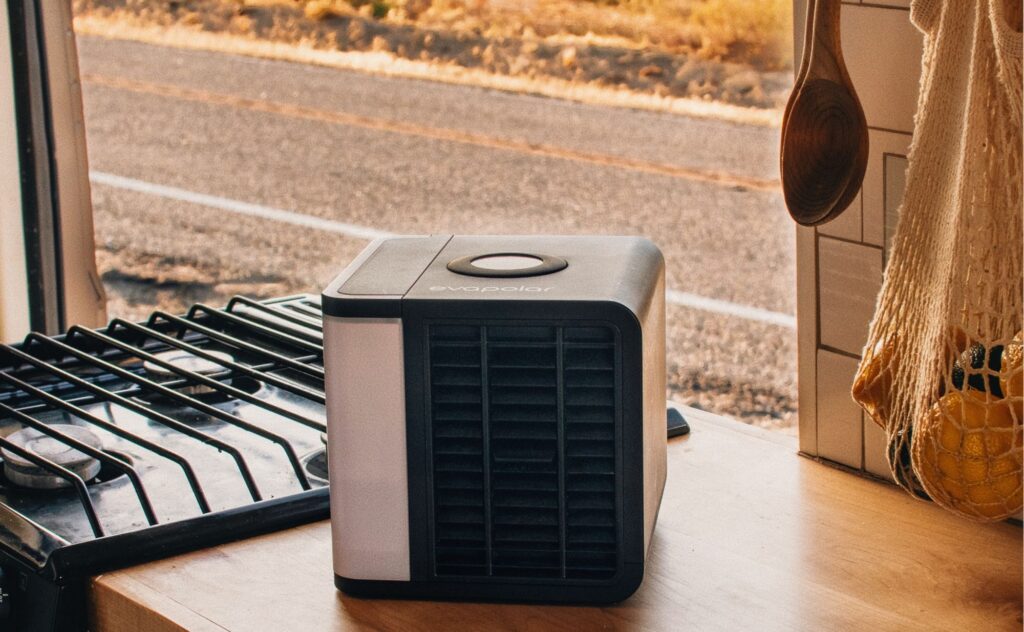
- Evaporative coolers draw warm air through water-saturated pads, lowering temperatures through natural evaporation. These units consume only 75 to 150 watts, making them excellent for boondocking where conserving power is essential. However, they lose effectiveness in humid environments because they increase indoor moisture levels.
- Traditional portable air conditioners utilize refrigerant-based compression cycles, delivering strong cooling regardless of humidity. They typically require 900 to 1,400 watts and must vent hot exhaust air outdoors using a window kit or custom port.
- Split portable systems separate the evaporator from the condenser, connecting them via refrigerant lines. This design reduces indoor noise and improves efficiency, though installation is more involved.
- Battery-powered portable ACs represent a newer innovation, leveraging lithium battery technology to deliver off-grid cooling for multiple hours. While convenient, their cooling output remains lower than plug-in alternatives.
Power Requirements and Electrical Considerations
Managing electrical load is one of the most critical steps when installing a portable air conditioner in an RV. Most motorhomes run on 12-volt DC battery power, 120-volt AC shore power, or onboard generators, each presenting different constraints. A standard portable unit drawing 1,000 to 1,200 watts requires roughly 10 amps at 120 volts, which most RV electrical panels handle comfortably when connected to shore power or a running generator.
Running such a unit off battery power through an inverter presents significant challenges. Continuous operation can drain even large lithium banks within two to three hours. To support off-grid cooling, many travelers install 400 to 800-watt solar arrays paired with 200 to 400 amp-hour lithium banks. Soft-start technology has also transformed portable AC compatibility by reducing startup surges by up to 70 percent, enabling operation on smaller generators and protecting delicate wiring.
Generator selection warrants careful planning. Experts generally recommend a minimum 2,000-watt inverter generator for stable portable AC operation. Many modern units include eco modes that cycle the compressor, balancing temperature stability with reduced energy draw.
Key Features to Evaluate When Choosing a System
When shopping for a portable air conditioner for motorhome applications, focus on specifications that directly impact performance and usability in confined spaces.
- Cooling capacity is measured in British Thermal Units (BTUs). Most motorhomes require 5,000 to 14,000 BTUs. A well-insulated 20-foot coach typically needs 8,000 to 10,000 BTUs, while 30 to 40-foot models often require 12,000 to 14,000 BTUs.
- Physical footprint and weight matter significantly. Units range from 40 to 80 pounds, and vertical designs help preserve valuable floor space.
- Noise levels directly affect comfort. Quality models operate between 50 and 55 decibels, whereas louder units exceed 65 dB and can disrupt sleep.
- Dual-hose configurations consistently outperform single-hose designs by pulling intake air from outside, preventing negative pressure that forces the compressor to work harder.
- Smart features like Wi-Fi connectivity, app controls, programmable timers, and sleep modes add convenience. Advanced air filtration options, including HEPA filters and ionizers, improve cabin air quality beyond basic temperature control.
- Condensate management varies by model. Some units feature continuous drain ports, internal evaporation systems, or removable collection tanks that require manual emptying every few hours.
Top-Rated Portable Air Conditioners for RV Use
Certain models have earned strong reputations among motorhome owners for reliability, efficiency, and real-world performance.
The Zero Breeze Mark 2 stands out as a battery-operated solution, delivering 2,300 BTUs of cooling while running for three to five hours on its internal pack. Weighing just 16.5 pounds with a compact 10 by 8 by 13-inch profile, it fits easily into small motorhomes and van conversions, though its output is best suited for spaces under 50 square feet.
The SereneLife SLPAC10 provides 10,000 BTUs at an accessible price point. Featuring a single-hose design, digital controls, remote operation, and a 24-hour timer, it runs at approximately 900 watts and produces 52 to 56 decibels of noise.
For heavier cooling demands, the Whynter ARC-14S delivers 14,000 BTUs through a dual-hose system, making it ideal for larger coaches and hot climates. Its patented auto-drain technology recycles condensate to cool the condenser coil, minimizing manual maintenance while boosting efficiency.
The Black+Decker BPACT14WT combines 14,000 BTUs of cooling with 11,000 BTUs of heating, extending usability into cooler seasons. Its adaptable window kit accommodates vertical and horizontal sliders common in RVs, and integrated casters allow effortless repositioning.
Installation and Setup Strategies
Successful deployment of a portable air conditioner for motorhome use goes beyond plugging the unit in. Proper exhaust venting is the primary challenge, with most travelers relying on adjustable window kits that seal around partially open windows using sliding panels and brackets. Some owners install permanent through-wall fittings that accept standard hoses while maintaining weatherproof seals when idle.
Hose routing heavily influences performance. Keep vent lines as short and direct as possible, ideally under five feet with no more than one 90-degree bend. Secure the unit firmly during transit using custom platforms, retention straps, or bungee cords to prevent damage from road vibrations. Strategic placement matters; position the unit where airflow circulates freely throughout the cabin while remaining close to an exterior opening.
Avoid placing the AC under cabinets or in tight corners, as restricted airflow can reduce cooling efficiency by 20 to 30 percent. Pair your portable system with reflective window covers, roof vents, and awnings to create a comprehensive cooling strategy. Build dedicated storage compartments to protect the investment and reclaim living space during cooler months.
Maximizing Cooling Efficiency in Your Motorhome
Improving your vehicle’s thermal envelope dramatically reduces the workload on your portable air conditioner and extends comfortable runtime on battery power. Adding radiant barriers like Reflectix, rigid foam panels, or spray foam to walls, ceilings, and floors can cut cooling demands by 30 to 50 percent.
Window treatments offer some of the highest returns on efficiency investments. Properly installed reflective shades block up to 80 percent of solar heat gain. Running roof vents and exhaust fans establishes cross-ventilation that pushes rising heat out while distributing cooled air. Parking strategy also plays a role; seeking shade and positioning your coach to minimize direct sun exposure on glass surfaces can lower interior temperatures by 10 to 20 degrees.
Pre-cool your motorhome before peak afternoon heat so the AC maintains comfort rather than fighting extreme temperatures. Seal gaps around doors, windows, and utility penetrations to prevent conditioned air loss, improving overall efficiency by 15 to 25 percent. Clean or replace air filters every two to four weeks to sustain optimal airflow. Upgrading to a portable air conditioner in rv systems engineered specifically for mobile environments ensures better durability and performance under vibration and temperature fluctuations.
Real-World Performance and User Feedback
Motorhome travelers report varied outcomes based on climate, vehicle size, and power availability. Forum discussions and user reviews consistently show that portable units effectively cool spaces under 200 square feet in moderate conditions, maintaining interior temperatures between 72