Best Portable RV Waste Tanks: Complete Buyer’s Guide for 2025
When traveling by RV, waste disposal is an unavoidable reality that directly impacts your comfort and freedom. A portable RV waste tank solves this challenge by dramatically improving your camping experience, particularly when boondocking or staying at locations with limited sewer hookups. These versatile containers allow you to extend your stay at remote destinations without constantly monitoring your built-in black or gray water tanks, preserving the independence that makes RV travel so rewarding.
The market for portable RV waste tanks has evolved significantly over the past decade. Manufacturers have introduced innovative designs that streamline waste management, making it less cumbersome and more efficient. Unlike permanently installed holding tanks, portable units offer unmatched flexibility and convenience, serving as auxiliary storage when your primary tanks reach capacity. This eliminates the need to break camp and drive your entire rig to a dump station mid-vacation. For many RVers, investing in a high-quality portable waste tank ranks among their most valuable purchases, sitting alongside essentials like leveling blocks and surge protectors.
Selecting the right portable RV waste tank requires careful evaluation of capacity, portability features, durability, and ease of use. Making the wrong choice can lead to frustrating experiences involving leaks, difficult maneuvering, or insufficient volume. This comprehensive guide covers everything you need to know about choosing, operating, and maintaining a portable waste tank that will serve you reliably for years.
Understanding Portable RV Waste Tanks and Their Purpose
A portable RV waste tank is a mobile storage container designed to extend your RV’s waste-holding capacity or provide a convenient method for transporting waste to a dump station. These units operate independently from your RV’s built-in plumbing systems. While your permanent black water tank holds toilet waste and your gray water tank collects sink and shower runoff, portable tanks function separately, giving you complete control over when and how you manage disposal.
The primary purpose of these tanks is to maximize camping autonomy. When parked at a scenic boondocking site without sewer connections, your built-in tanks will eventually fill. Instead of packing up your entire setup and driving to a dump station, you can drain your RV’s tanks into the portable unit, transport only the portable tank to the facility, empty it, and return to your campsite. This process takes a fraction of the time and effort compared to moving your rig, allowing you to spend more time enjoying your destination.
Portable waste tanks excel in multiple scenarios beyond simple boondocking. They are invaluable when a campground’s sewer connection is inconveniently located or when dealing with a malfunctioning hookup. Some travelers dedicate their portable tank exclusively to gray water, extending stays without worrying about dishwater or shower runoff accumulation. Others keep them as emergency backups for unexpected situations like a broken sewer valve or overcrowded dump stations. This versatility makes them one of the most practical investments for serious RVers who prioritize independence.
Key Features to Look for in a Portable RV Waste Tank
Tank Capacity and Size Considerations
Capacity is the most critical specification when selecting a portable RV waste tank. Models typically range from 15 gallons to 42 gallons, with some specialized units offering even larger volumes. Your ideal capacity depends on your RV size, group size, and typical duration between dump station visits. A couple traveling in a compact camper van may find a 15 to 20-gallon tank perfectly adequate, while a family of four in a large motorhome will benefit from a 35 to 42-gallon capacity.
Balancing capacity with portability is essential. A fully loaded 42-gallon tank weighs approximately 350 pounds, which presents significant handling challenges even with a wheeled base. Larger tanks reduce the number of trips to the dump station but demand more physical effort to maneuver over uneven terrain or ramps. Many experienced RVers recommend choosing a tank with roughly half the capacity of your RV’s largest built-in tank. This approach allows you to drain your primary tanks completely while keeping the weight manageable for solo transport.
- 15 gallons: Weighs approximately 125 lbs when full. Ideal for solo travelers and van campers on weekend trips or for gray water only.
- 20-25 gallons: Weighs approximately 165-210 lbs. Best suited for couples and small trailers during extended weekend camping.
- 28-32 gallons: Weighs approximately 235-270 lbs. Perfect for small families and mid-size RVs tackling week-long boondocking trips.
- 35-42 gallons: Weighs approximately 290-350 lbs. Designed for large families and big motorhomes requiring extended off-grid stays.
Wheel and Towing Mechanism Quality
The wheel system determines how easily you can transport the tank when full. Premium models feature large-diameter wheels, typically 8 inches or larger, which roll smoothly over gravel, grass, and uneven campground surfaces. Smaller wheels frequently get stuck in soft ground or struggle with obstacles like rocks and tree roots. Wheel material also matters; solid rubber or pneumatic tires provide superior shock absorption and durability compared to cheap plastic alternatives that crack under heavy loads.
The towing mechanism should allow comfortable pulling at a natural walking height. Quality portable RV waste tanks include telescoping handles that extend for use and retract for storage. Look for ergonomic grips that prevent hand fatigue when hauling heavy loads. Some premium models incorporate rotational towing handles, enabling you to pull the tank at various angles to navigate tight spaces or bypass obstacles. Ensure the handle connects to the tank body via reinforced metal brackets rather than relying solely on plastic joints that may fail under stress.
Durability and Construction Materials
Construction quality separates tanks that last decades from those that crack and leak after one season. High-density polyethylene (HDPE) is the industry gold standard due to its exceptional durability, chemical resistance, and ability to withstand extreme temperatures. Quality HDPE tanks remain flexible in cold weather and resist warping in direct summer sun. Tank walls should be thick enough to resist punctures and impacts, typically measuring at least 3 to 4 millimeters in well-engineered units.
Seam construction deserves close attention since most leaks originate here. Rotomolded tanks, manufactured through rotational molding, are seamless and eliminate the most common failure point. Tanks constructed from multiple welded pieces can perform well if seams are properly reinforced, but they carry a higher risk of eventual leakage. Look for reinforcement ribs or structural supports molded directly into the tank body, which help maintain shape under full weight and prevent bulging or stress cracking over time.
Top Types of Portable RV Waste Tanks
Standard Tote-Style Tanks
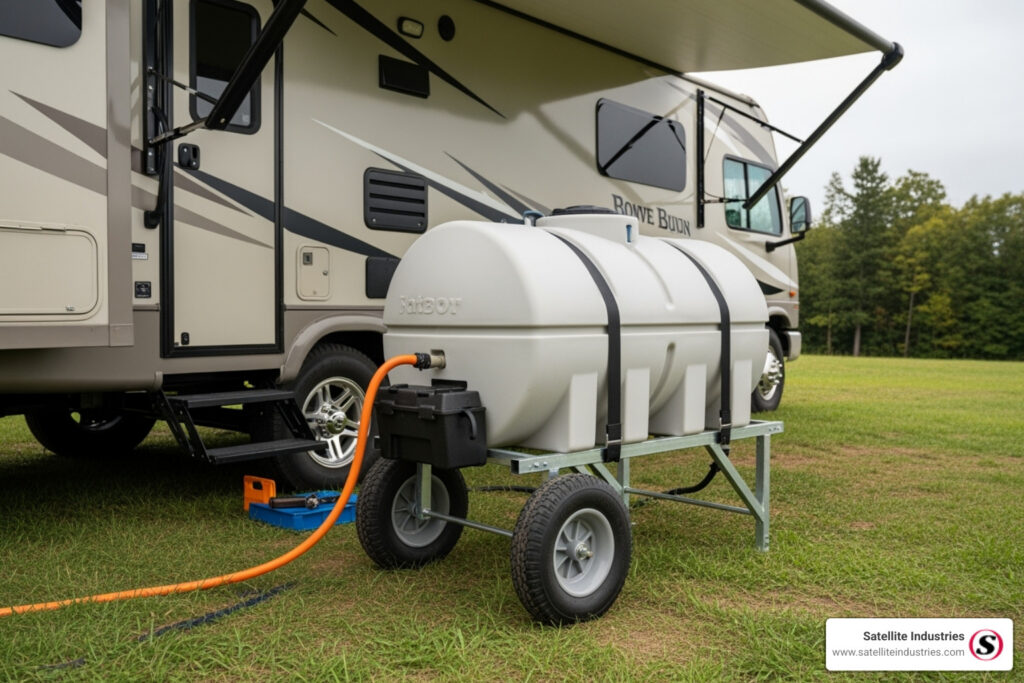
Standard tote-style portable RV waste tanks represent the most common and affordable option for RVers. These rectangular or slightly rounded tanks sit low to the ground on a wheeled platform, featuring a large top opening for filling and cleaning. The low profile ensures stability during transport and simplifies filling from your RV’s dump valves. Most tote tanks include a 3-inch inlet opening compatible with standard RV sewer hoses, along with a smaller outlet for draining at the dump station.
The simplicity of tote-style tanks contributes to their reliability and straightforward maintenance. With fewer moving parts and uncomplicated designs, there is minimal room for mechanical failure. Cleaning is relatively easy because the wide top opening provides clear visibility and access for cleaning wands. The main drawback is that tote tanks generally offer less volume than taller designs due to their lower height, and their utilitarian appearance may not appeal to everyone. However, for budget-conscious campers or beginners, tote-style units provide excellent entry-level functionality without sacrificing core performance.
Portable Blue Boy Style Tanks
The Blue Boy style tank, named after the iconic original design, features a tall cylindrical shape that maximizes volume while maintaining a compact footprint. These vertical tanks hold 30 to 42 gallons while occupying minimal floor space, making them ideal for RVers with limited storage areas. The vertical orientation also improves natural drainage flow, as gravity moves waste more efficiently down the taller column.
Modern Blue Boy style tanks have evolved significantly from their predecessors, incorporating advanced wheel systems, upgraded materials, and improved sealing mechanisms. The tall design creates a higher center of gravity compared to tote tanks, which can affect stability on extremely uneven terrain. However, quality models counteract this with wider wheelbases. The narrower profile also makes these tanks easier to maneuver through tight spaces between vehicles or around campsite obstacles, offering a distinct advantage in crowded campgrounds.
Heavy-Duty Professional Grade Tanks
Professional grade portable waste tanks cater to RVers who demand maximum durability and performance. These premium units feature extra-thick walls, commercial-grade wheels, reinforced stress points, and heavy-duty fittings built to withstand years of frequent use. Many professional tanks include built-in level indicators, integrated hose storage, and advanced valve systems that simplify operation. While the price point runs significantly higher than standard models, the investment pays dividends in reliability and longevity for full-time RVers or frequent boondockers.