Best Marine VHF Portable Radio: Your Essential Guide to Safe Boating Communication
Marine communication can mean the difference between a routine voyage and a life-threatening emergency. A reliable marine VHF portable radio serves as your lifeline on the water, connecting you to Coast Guard services, nearby vessels, and harbor authorities. Whether you are a weekend sailor, commercial fisherman, or seasoned yachtsman, understanding how to select and operate these critical safety devices ensures you are never truly alone at sea. This comprehensive guide covers everything you need to know about portable marine VHF radios, from technical specifications to real-world applications.
What Is a Marine VHF Portable Radio?
A marine VHF portable radio is a handheld two-way communication device engineered specifically for maritime environments. It operates on Very High Frequency (VHF) bands between 156 and 174 MHz, offering reliable ship-to-ship and ship-to-shore connectivity. Unlike standard walkie-talkies or cellular phones, these radios are built to endure saltwater exposure, heavy rain, and rough handling. Features such as waterproof construction, floating designs, and dedicated emergency channels make them indispensable safety gear for open-water navigation.
These units must comply with international maritime regulations, including mandatory Channel 16 monitoring whenever the device is powered on. Modern technology has advanced significantly from early analog systems to include Digital Selective Calling (DSC), which automatically transmits distress signals paired with GPS coordinates. Today’s best marine VHF portable radios also feature noise cancellation, extended battery life, and submersible waterproof ratings that exceed IPX7 standards.
Why Every Boater Needs a Portable Marine VHF Radio
Safety and emergency response capabilities are the primary reasons to carry a portable VHF marine radio. During critical incidents—such as man-overboard situations, engine failure, medical emergencies, or severe weather—your handheld radio becomes the direct link to rescue services. Unlike fixed-mount vessel radios, portable units can be carried into life rafts, kayaks, or dinghies if you ever need to abandon ship.
The communication range advantage over cellular networks becomes obvious once you move beyond coastal waters. While cell towers typically cover only a few miles inland, marine VHF radios can reach up to 60 nautical miles under ideal conditions with tall antennas. Practical handheld range averages 5 to 8 nautical miles, depending on antenna height and atmospheric conditions. This extended reach proves invaluable when requesting assistance from passing vessels or Coast Guard stations.
Regulatory compliance and international recognition ensure your communications are understood globally. Modern units support DSC capabilities, allowing automated distress alerts with exact coordinates. Registering your Maritime Mobile Service Identity (MMSI) enables authorities to instantly identify your vessel and access vital information when you transmit a distress call.
Essential Features of Quality Marine VHF Portable Radios
Waterproofing and Buoyancy Standards
Professional-grade handheld marine radios must meet strict waterproofing requirements to function reliably at sea. An IPX7 rating indicates protection against submersion up to one meter for thirty minutes, while IPX8 offers higher standards with deeper or longer submersion capabilities. Premium models often feature floating designs with integrated strobe lights that activate upon water contact, greatly simplifying retrieval after accidental drops or man-overboard events.
Buoyancy combined with high-visibility colors like bright yellow or international orange ensures your radio stays visible in choppy seas or low light. Some advanced models include SOS strobe lights visible up to one nautical mile away, serving dual purposes as both communication tools and emergency beacons.
Digital Selective Calling (DSC) Capability
DSC-capable radios can be programmed with MMSI numbers to automatically transmit distress signals containing vessel identification, position coordinates, and emergency type. This digital system operates on dedicated Channel 70, continuously monitoring for distress calls while allowing simultaneous voice communication on other frequencies. When paired with GPS receivers, DSC radios provide Search and Rescue teams with real-time tracking, dramatically cutting response times during crises.
Automatic hailing lets you contact specific vessels using their MMSI numbers instead of broadcasting general calls, reducing channel congestion. Group calling functions support fleet communications, while priority channels ensure distress signals override routine transmissions. These capabilities transform your portable VHF from a basic voice transmitter into a sophisticated digital safety network.
Battery Performance and Power Management
Battery endurance directly impacts operational reliability during long voyages or emergencies. Modern portable marine VHF radios deliver 10 to 29 hours of standby time, depending on activated features and power settings. Lithium-ion rechargeable batteries offer superior energy density compared to older nickel-metal hydride options, while emergency alkaline battery trays provide backup power when recharging is impossible.
Smart power management features include automatic power reduction on local ship-to-ship channels, typically dropping output from six watts to one watt. This intelligent scaling conserves battery life while maintaining clear signal strength for nearby vessels. USB charging compatibility allows convenient power replenishment from portable banks, vehicle outlets, or solar panels, making it ideal for extended cruising.
GPS Integration and Position Tracking
Built-in GPS receivers eliminate the need for separate position-finding devices while unlocking critical safety functions. Integrated GPS enables waypoint navigation, position sharing with other boats, and automatic coordinate inclusion in distress transmissions. The man-overboard (MOB) function locks onto the exact location where a crew member falls, providing precise rescue coordinates even in darkness or poor visibility.
Position tracking supports voyage planning and automatically logs traveled routes. Combined with DSC technology, GPS-equipped radios create comprehensive safety systems that deliver rescuers with exact location data, weather updates, and continuous position tracking throughout an emergency.
Top Marine VHF Portable Radio Models in 2025
Standard Horizon HX890: Premium All-Feature Radio
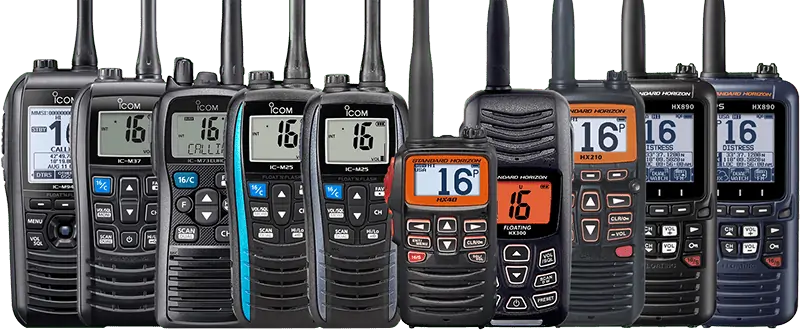
The Standard Horizon HX890 consistently ranks among the most comprehensive portable marine VHF radios available. This feature-packed model combines DSC capability, a built-in GPS receiver, and IPX8 waterproofing with 27 hours of standby battery life. Its floating design includes an automatically activated strobe light upon immersion, ensuring high visibility during nighttime emergencies or man-overboard scenarios.
Advanced capabilities include tri-watch monitoring, which allows simultaneous surveillance of Channel 16 emergency broadcasts, vessel traffic channels, and crew communications. The large, high-resolution screen displays detailed navigation data, waypoints, and channel information. Weighing 310 grams, it is slightly bulkier than entry-level models, but the professional-grade feature set justifies the weight for serious mariners.
ICOM M94D: AIS-Equipped Innovation Leader
The ICOM M94D stands out as the first handheld radio to bundle an Automatic Identification System (AIS) receiver with DSC, GPS, and VHF capabilities in a single unit. This integration dramatically improves situational awareness by displaying nearby vessel traffic on-screen. Boaters can directly hail specific ships using their AIS identifiers, a crucial advantage in busy shipping lanes or crowded harbors.
Battery performance delivers approximately 16 hours on standby with three-hour rapid charging. The IPX7 waterproof rating, combined with floating and flashing features, ensures quick recovery if dropped overboard. AquaQuake technology automatically expels water from the speaker after submersion, preserving audio clarity. The larger screen accommodates simultaneous AIS targets, navigation data, and active channels, though the added functionality increases weight to 367 grams.
Cobra HH500: Bluetooth-Enhanced Communication
The Cobra HH500 introduces innovative Bluetooth connectivity, enabling waterproof mobile phone calls routed through the marine radio. This unique feature keeps smartphones safely stored below deck while maintaining cellular service in covered areas. The rewind function automatically records the last 20 seconds of transmissions, allowing operators to replay missed instructions during fast-paced emergency communications.
Battery life reaches 16 hours on standby while monitoring busy channels, with charging handled via a drop-in cradle compatible with 12-volt and 240-volt power sources. An emergency alkaline tray accepts five AA batteries for backup power. With integrated DSC and GPS, this model delivers full safety functionality at a moderate price point, offering excellent value for recreational boaters.
Standard Horizon HX210: Budget-Friendly Reliability
For boaters seeking core functionality without premium pricing, the Standard Horizon HX210 delivers dependable performance at approximately $167. Its compact form factor provides 29 hours of battery life, IPX7 waterproofing, and floating capability. While it lacks DSC and GPS, it excels at essential communication tasks with clear audio output and straightforward menu navigation.
The face-up floating design includes a water-activated strobe light to aid recovery if lost overboard. An integrated FM radio tuner provides entertainment and emergency broadcast monitoring. The charging cradle supports both 12-volt and 240-volt inputs, though USB charging is not included. This model is ideal for budget-conscious sailors