Whether you’re running a small machine shop, a busy warehouse, or managing field operations, a portable gantry crane is one of the most practical lifting investments you can make. Unlike fixed overhead cranes that require permanent installation, portable gantry cranes give you full mobility — move them anywhere, set them up in minutes, and lift heavy loads with confidence.
This post breaks down everything you need to know: types, load capacities, key features, safety standards, cost comparisons, and buying tips. Read on before you spend a single dollar.
What Is a Portable Gantry Crane?
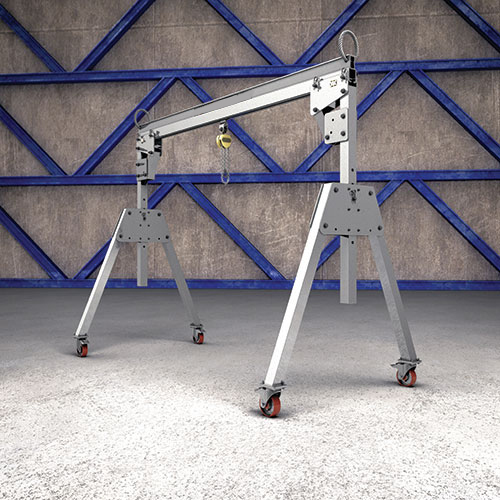
A portable gantry crane is a freestanding, movable lifting device built from an A-frame or H-frame structure supported by casters or wheels. It straddles a load and uses a hoist or trolley system mounted on a horizontal beam to lift, lower, and reposition heavy items. Unlike ceiling-mounted bridge cranes, portable gantry cranes require zero structural modification to your building.
They are widely used in:
- Machine shops for moving engines, dies, and fixtures
- Warehouses for loading and unloading pallets
- Construction sites for placing heavy materials
- Auto repair shops for pulling and setting engines
- Shipyards and docks for component assembly
“A portable gantry crane is arguably the most flexible lifting tool available to small and mid-size operations — it delivers overhead crane capability without the overhead cost.” — Materials Handling Industry Association (MHIA)
Types of Portable Gantry Cranes
Understanding the different types helps you choose the right crane for your specific lifting tasks. Each type is built for a different load range, environment, and frequency of use.
1. Adjustable Height Portable Gantry Cranes
These are the most popular models on the market. The upright legs can be raised or lowered using pin-and-hole or screw-adjust mechanisms. This makes them extremely versatile — you can lower the beam height to pass through standard doorways, then raise it to full height on the work floor.
Best for: Multi-location shops, rental fleets, general manufacturing.
2. Fixed Height Portable Gantry Cranes
Fixed-height models are built for dedicated work areas where consistent lift height is always needed. They are typically more rigid and slightly heavier than adjustable models. Because there are fewer moving parts, they tend to be more durable under high-cycle use.
Best for: Production lines, repetitive lifting tasks, high-frequency environments.
3. Folding Portable Gantry Cranes
Folding cranes are designed for maximum portability. The A-frame legs fold inward so the entire unit can be rolled through a standard door or loaded into a pickup truck bed. They are popular with mobile service technicians and field crews who need lifting capability at multiple job sites.
Best for: Field technicians, HVAC installers, remote job sites.
4. Aluminum Portable Gantry Cranes
Aluminum cranes are significantly lighter than steel models — sometimes 60–70% lighter — while still delivering impressive load capacity. They are corrosion-resistant, making them ideal for marine, food processing, and outdoor environments. Their reduced weight makes repositioning by a single operator much easier.
Best for: Marine environments, cleanrooms, outdoor applications.
5. Steel Portable Gantry Cranes
Steel cranes offer higher load capacities and better durability for rough industrial environments. They are heavier but can handle loads ranging from 1 ton up to 20 tons or more. If your lifting demands are heavy and frequent, steel is typically the smarter long-term investment.
Best for: Heavy manufacturing, fabrication shops, industrial maintenance.
Portable Gantry Crane Load Capacity Range
| Crane Type | Typical Capacity Range | Common Applications |
|---|---|---|
| Aluminum Folding | 500 lbs – 2 tons | Light assembly, field work |
| Adjustable Steel | 1 ton – 5 tons | Machine shops, warehouses |
| Fixed Height Steel | 2 tons – 10 tons | Production lines, fabrication |
| Heavy-Duty Industrial | 5 tons – 20+ tons | Heavy manufacturing, shipyards |
Important: Always verify the rated capacity on the crane’s data plate before lifting. Never exceed the manufacturer’s stated Working Load Limit (WLL).
Key Components of a Portable Gantry Crane
Knowing what makes up a portable gantry crane helps you evaluate quality and compare models accurately. Here are the core components every buyer should understand.
The Main Beam (Bridge)
The main beam is the horizontal structural member that spans the top of the crane. It supports the trolley and hoist. Beams are typically I-beams or box beams, with I-beams being preferred for underhung hoist applications. Beam length directly determines your lifting span — how far apart your load and the supporting structure can be.
Upright Legs
The upright legs are the vertical supports that hold the beam. On adjustable-height models, the legs consist of an outer tube and an inner tube that telescope together. The adjustment mechanism — whether it’s a pin-and-hole system or a thread screw — affects how quickly you can change heights on the job.
Base Legs and Casters
The base legs extend outward at the bottom of each upright, creating a wide stable footprint. Casters (wheels) are mounted at the ends of the base legs. Most quality portable gantry cranes use 360-degree swivel casters, some with locking mechanisms to prevent movement during a lift. Larger-diameter casters roll more easily over rough floors.
Hoist System
The hoist is the mechanism that does the actual lifting. Three types are common:
- Chain hoist (manual): Operator pulls a chain to raise and lower the load. Low cost, low maintenance.
- Electric chain hoist: Motor-driven, controlled by a pendant button. Faster and less fatiguing for frequent lifts.
- Electric wire rope hoist: Used for heavier loads and longer lift heights. More precise control.
Trolley
The trolley is a carriage that rides along the bottom flange of the main beam, allowing the load to be moved horizontally along the crane’s span. Manual push trolleys are standard. Motorized trolleys are available for production environments requiring frequent horizontal travel.
How to Size a Portable Gantry Crane Correctly
Choosing the wrong size is the number one buyer mistake. Here is a straightforward sizing process.
Step 1 — Determine your maximum load weight. Identify the heaviest single item you will ever lift. Do not estimate — weigh it. Add 25% as a safety buffer.
Step 2 — Determine your required lift height. Measure the maximum height you need to raise the bottom of your load. Add clearance for the hoist, hook, and rigging hardware (typically 12–18 inches).
Step 3 — Determine your required span. Measure the width of the load plus any clearance needed on each side. This determines the minimum main beam length.
Step 4 — Check your floor space. The base legs extend outward beyond the uprights. Make sure your facility has enough room for the full footprint of the crane plus safe working clearance around it.
Step 5 — Factor in duty cycle. If you lift infrequently (a few times per week), a standard-duty crane is fine. For daily or multi-shift use, look for heavy-duty or industrial-grade ratings.
OSHA and ASME Standards for Portable Gantry Cranes
Safety compliance is not optional. In the United States, portable gantry cranes are regulated under several key standards.
OSHA 29 CFR 1910.179
This standard governs overhead and gantry cranes in general industry. Key requirements include:
- Load test prior to initial use — cranes must be tested at 125% of rated load
- Inspection records — frequent and periodic inspections must be documented
- Rated load markings — capacity must be clearly marked on the crane
ASME B30.2
Published by the American Society of Mechanical Engineers, B30.2 covers overhead and gantry cranes and sets detailed design, inspection, and operating requirements.
Inspection Requirements
| Inspection Type | Frequency | Who Performs It |
|---|---|---|
| Pre-use visual check | Before each use | Operator |
| Frequent inspection | Daily to monthly | Designated person |
| Periodic inspection | 1–12 months | Qualified inspector |
Pro tip: Keep a logbook for all inspections. OSHA inspectors routinely request these records during facility audits.
Portable Gantry Crane vs. Fixed Gantry Crane: Which Is Right for You?
| Factor | Portable Gantry Crane | Fixed Gantry Crane |
|---|---|---|
| Installation | None required | Structural mounting required |
| Mobility | Fully mobile | Stationary |
| Setup time | 15–30 minutes | Permanent |
| Cost | $500 – $15,000+ | $5,000 – $50,000+ |
| Capacity | Up to 20+ tons | Up to 100+ tons |
| Best for | Small to mid-size shops, field use | Dedicated heavy-use production |
For most small businesses and workshops, a portable gantry crane delivers 80% of the capability of a fixed crane at a fraction of the cost and complexity.
Top Features to Look for When Buying a Portable Gantry Crane
Not all portable gantry cranes are created equal. Here are the features that separate quality products from budget disappointments.
✅ Adjustable Height
Height adjustability is one of the most practical features available. Look for models with a wide adjustment range and a mechanism that one person can operate safely without tools. Pin-and-hole systems are faster; screw systems offer more precise height settings.
✅ Heavy-Duty Casters with Locking Brakes
The casters carry the full loaded weight of every lift. Look for polyurethane or steel casters rated well above the crane’s WLL. Every caster should have a reliable locking brake that keeps the crane stationary during lifting operations.
✅ Beam Type and Quality
An I-beam profile is structurally superior to a simple flat bar or channel for underhung hoist applications. Look for cranes that specify beam material grade (A36 or A572 steel are common standards).
✅ Compatibility with Standard Hoists
The best portable gantry cranes are designed to accept industry-standard electric or manual chain hoists without custom adapters. Verify bottom flange width compatibility before purchasing a hoist separately.
✅ Powder Coat or Galvanized Finish
A quality surface finish protects against rust and corrosion, extending the crane’s service life — especially in humid, outdoor, or marine environments. Cheap cranes often use thin paint that chips quickly.
✅ Assembly Without Welding
Quality portable gantry cranes use bolted connections throughout. This makes field assembly possible without special tools or skills. Avoid cranes that require field welding for assembly — this introduces variable quality and safety risk.
Portable Gantry Crane Cost Breakdown
Here is a realistic cost overview for different configurations:
| Configuration | Estimated Cost |
|---|---|
| Light-duty aluminum (1 ton, manual hoist) | $600 – $1,500 |
| Mid-range steel adjustable (2 ton, manual hoist) | $1,500 – $3,500 |
| Mid-range steel (2 ton, electric chain hoist) | $2,500 – $5,000 |
| Heavy-duty steel (5 ton, electric hoist) | $5,000 – $10,000 |
| Industrial heavy-duty (10–20 ton) | $10,000 – $25,000+ |
Note: Prices vary significantly by brand, capacity, span, and included hoist. Always compare total cost of ownership — a cheap crane with poor casters and thin beam quality will cost more in maintenance and replacement than a quality unit purchased once.
Case Study: Small Auto Shop Switching to a Portable Gantry Crane
Background: A 3-bay independent auto repair shop in Texas was renting a mobile engine hoist at $75/day whenever they needed to pull an engine. On average, they were renting 3–4 times per month.
Problem: Monthly rental costs averaged $270/month ($3,240/year). The shop also lost productive time waiting for delivery and return.
Solution: The owner purchased a 2-ton adjustable-height portable gantry crane with an electric chain hoist for $3,800 total.
Result:
- Break-even achieved in approximately 14 months
- Eliminated all rental delays and scheduling friction
- The crane was used for engine pulls, transmission drops, and brake drum handling — far more versatile than the rented hoist
- After 3 years, total savings exceeded $5,800
This case illustrates a pattern repeated across small shops and field operations: the upfront investment in a quality portable gantry crane pays back quickly when rental or labor costs are properly calculated.
Portable Gantry Crane Assembly: What to Expect
Most mid-range portable gantry cranes arrive partially assembled and can be set up by two people in 30–60 minutes. Here is the general process:
- Unbox and inventory all components — check against the packing list before assembly begins
- Assemble the A-frame legs — connect upright tubes to base legs using provided hardware
- Set leg height — adjust both uprights to the desired height and lock in place
- Install the main beam — lift the beam onto the leg tops and secure with bolts or pins
- Attach trolley and hoist — slide the trolley onto the beam flange before securing beam ends; install the hoist per manufacturer instructions
- Inspect all connections — verify all bolts are torqued to specification
- Perform a no-load test — roll the crane, cycle the hoist, and check for any binding or instability
- Perform a low-load test — lift a known weight at 50% capacity before full use
Safety reminder: Never perform a lift without confirming all four caster brakes are fully engaged and all structural connections are properly secured.
Portable Gantry Crane Maintenance Schedule
Regular maintenance extends service life and prevents safety incidents. Follow this basic schedule:
| Task | Frequency |
|---|---|
| Visual inspection of all welds and structural connections | Before each use |
| Caster lubrication | Monthly |
| Hoist chain lubrication | Monthly or per manufacturer spec |
| Check and tighten all bolts | Every 3 months |
| Inspect hoist brake function | Every 3 months |
| Load test at rated capacity | Annually |
| Full structural inspection by qualified person | Annually |
Keep all maintenance records in a dedicated logbook stored with the crane. This is not just good practice — it is an OSHA requirement for industrial settings.
How to Use a Portable Gantry Crane Safely
Safe operation starts before the lift begins. Follow these steps on every job:
- Inspect the crane before each use — check all pins, bolts, welds, casters, and hoist components
- Verify load weight — never guess; confirm the load is within the crane’s rated capacity
- Clear the lift zone — remove all personnel from the area beneath and around the load
- Use proper rigging — slings, chains, and shackles must each be rated for the load weight
- Lift slowly and smoothly — avoid sudden movements, jerking, or shock loading
- Keep loads low during travel — when moving the crane with a suspended load, keep the load as close to floor level as safely possible
- Lock casters before lifting — never lift with unlocked wheels
- Never exceed rated capacity — not even briefly
Also note that if you work with other portable equipment on site — such as a portable grit blaster — maintaining a clear and organized work zone around all portable equipment reduces accident risk significantly.
Common Portable Gantry Crane Mistakes to Avoid
Even experienced operators make preventable mistakes. Here are the most common ones:
| Mistake | Risk | Prevention |
|---|---|---|
| Exceeding rated capacity | Structural collapse | Weigh loads; never estimate |
| Forgetting to lock casters | Crane rolls during lift | Always lock all 4 casters |
| Using damaged rigging | Load drop | Inspect rigging before every lift |
| Lifting over personnel | Serious injury or death | Enforce exclusion zone policy |
| Side loading the beam | Beam failure | Only lift directly below the hoist |
| Skipping pre-use inspection | Undetected wear | Make inspection a fixed habit |
Frequently Asked Questions About Portable Gantry Cranes
What is the maximum capacity of a portable gantry crane?
Most commercially available portable gantry cranes are rated from 500 lbs up to 20 tons. Specialty heavy-duty models can exceed this. Always match the crane’s rated capacity to your maximum anticipated load with an appropriate safety margin.
How much does a portable gantry crane weigh?
Weight varies widely by material and capacity. A light-duty aluminum portable gantry crane rated at 1 ton may weigh as little as 150–200 lbs. A heavy-duty steel model rated at 5 tons can weigh 700–1,200 lbs or more. Heavier cranes typically require a forklift or multiple people to reposition.
Do I need a permit to use a portable gantry crane?
In most cases, no permit is required for indoor use on private property. However, OSHA regulations require that operators be trained and that the crane meets applicable standards. For outdoor or public-area use, local regulations may apply — check with your local authority.
Can one person operate a portable gantry crane?
Yes, single-operator use is common for many portable gantry crane applications — particularly with an electric chain hoist and a motorized trolley. However, rigging and load positioning often benefit from a second person, and OSHA recommends a designated signal person for any lift where the operator’s view is obstructed.
How long does it take to assemble a portable gantry crane?
Most standard models can be assembled by two people in 30–60 minutes using basic hand tools. Folding models may assemble even faster. Always follow the manufacturer’s assembly instructions precisely — improvised assembly is a leading cause of portable gantry crane incidents.
What is the difference between a gantry crane and an overhead crane?
A gantry crane is self-supporting and stands on the floor on its own legs. An overhead crane (bridge crane) is suspended from the building structure — typically from runway rails mounted to columns or roof beams. Portable gantry cranes need no building structure; overhead cranes require significant structural support and permanent installation.
Can a portable gantry crane be used outdoors?
Yes. Many portable gantry cranes are designed for outdoor use. For outdoor applications, choose a model with corrosion-resistant materials (aluminum or galvanized steel), sealed hoist components, and wide-diameter casters suitable for uneven surfaces. Avoid use in high winds — consult the manufacturer’s environmental operating limits.
How do I choose the right hoist for my portable gantry crane?
Match the hoist’s rated capacity to the crane’s rated capacity — never use a hoist rated higher than the crane structure. Choose an electric chain hoist for frequent lifts, heavy production environments, or when operator fatigue is a concern. Manual chain hoists are cost-effective for occasional lifting. Always verify that the hoist’s bottom hook gap is compatible with your rigging hardware.
Where to Buy a Portable Gantry Crane
When sourcing a portable gantry crane, you have several options:
Direct from manufacturers: Brands like Spanco, Wallace Cranes, and Vestil manufacture quality gantry cranes sold through industrial distributors. Buying directly or through authorized distributors ensures genuine product with full warranty support.
Industrial distributors: Grainger, MSC Industrial, and similar distributors stock a wide range of portable gantry cranes with same-day or next-day shipping. They also offer technical support for selecting the right model.
Online specialty retailers: Specialty lifting equipment retailers often offer competitive pricing and expertise. Look for retailers who provide detailed technical specifications, not just basic product listings.
Used equipment: Used portable gantry cranes can offer significant savings. Always request full inspection records, verify the crane has no structural damage, and confirm it meets current safety standards before purchasing.
Ready to Lift Smarter? Shop a Portable Gantry Crane Today
If you’ve made it this far, you now have a solid foundation for choosing the right crane. Don’t let lifting bottlenecks slow your operation down. A quality portable gantry crane pays for itself fast — in time saved, injuries prevented, and jobs completed more efficiently.
Browse our full selection of portable gantry cranes and find the right capacity, height range, and configuration for your specific application. Whether you need a compact folding aluminum crane for field work or a heavy-duty steel crane for daily shop use, the right solution is ready to ship.
Shop Portable Gantry Cranes Now →
Citation: Portable gantry crane design and safety standards referenced from the American Society of Mechanical Engineers (ASME) B30.2 standard and OSHA 29 CFR 1910.179. Always consult applicable local, state, and federal regulations before operating lifting equipment.