Portable Product Guides for Life AnywhereBuying Guides · Comparisons · How-To
Portable GuideOther Portable

Commercial Cool Portable Air Conditioner: Your Complete Buying and Setup Guide for 2025

Why Choose a Commercial Cool Portable AC Unit? When summer temperatures soar and you need immediate cooling relief, a commercial cool portable air conditioner offers […]
Commercial Cool Portable Air Conditioner

Why Choose a Commercial Cool Portable AC Unit?

When summer temperatures soar and you need immediate cooling relief, a commercial cool portable air conditioner offers the perfect solution for homes, offices, and commercial spaces. Unlike traditional window units or central air systems that require expensive installation and permanent modifications, portable AC units provide flexible, cost-effective cooling that you can move from room to room as needed. The Commercial Cool brand has established itself as a reliable option in the portable cooling market, offering features like energy efficiency, user-friendly controls, and powerful cooling capacity at competitive price points.

Whether you’re cooling a bedroom, home office, small apartment, or commercial workspace, understanding how to select and optimize your portable air conditioner can make the difference between sweltering through hot days and enjoying comfortable, climate-controlled environments throughout the warmest months.

What Makes Commercial Cool Portable Air Conditioners Stand Out?

The commercial cool portable air conditioner line distinguishes itself through several key advantages that appeal to both residential and light commercial users. These units typically feature BTU ratings ranging from 8,000 to 14,000, making them suitable for cooling spaces between 250 and 500 square feet depending on the model. Commercial Cool designs incorporate digital LED displays, remote control operation, and programmable 24-hour timers that allow you to set cooling schedules that match your daily routine.

The brand emphasizes straightforward installation with included window kits, exhaust hoses, and clear instructions that enable most users to set up their units within 30 minutes without professional help. Energy efficiency ratings meet or exceed industry standards, helping you keep electricity costs manageable during peak cooling season. Additionally, Commercial Cool portable AC units often include multi-function capabilities, serving as air conditioners, dehumidifiers, and fans in a single appliance.

Key Features of Commercial Cool Models

Commercial Cool portable air conditioners incorporate several standout features that enhance their functionality and user experience:

  • Multiple Operating Modes: Air conditioning, fan-only, and dehumidification modes provide year-round climate control options
  • Auto-Restart Function: Automatically resumes previous settings after power outages, maintaining your comfort without manual intervention
  • Sleep Mode: Gradually adjusts temperature throughout the night to optimize comfort while reducing energy consumption
  • Washable Air Filters: Removable, reusable filters capture dust, pollen, and allergens while reducing maintenance costs
  • Caster Wheels: Built-in rolling casters enable effortless movement between rooms, maximizing your investment
  • Digital Controls: Intuitive LED displays and remote controls simplify temperature adjustments from across the room

Understanding BTU Ratings and Room Size Requirements

Selecting the right BTU (British Thermal Unit) capacity represents the most critical decision when purchasing a commercial cool portable air conditioner. BTU measures cooling power—the higher the BTU rating, the larger the space the unit can effectively cool. A common mistake involves either undersizing or oversizing your air conditioner, both of which create problems. An undersized unit runs constantly without achieving comfortable temperatures, wasting energy and wearing out components prematurely.

An oversized unit cycles on and off too frequently, failing to properly dehumidify the air and creating uncomfortable humidity levels. For optimal performance, match your room dimensions to the appropriate BTU rating using industry-standard calculations that account for ceiling height, insulation quality, sun exposure, and heat-generating appliances or electronics.

BTU Requirements by Room Size

Room Size (Square Feet) Recommended BTU Rating Typical Commercial Cool Model
150-250 sq ft 8,000 BTU CPD08XC9, CPPH08XC9
250-350 sq ft 10,000 BTU CPD10XC9, CPPH10XC9
350-450 sq ft 12,000 BTU CPD12XC9, CPPH12XC9
450-550 sq ft 14,000 BTU CPD14XC9, CPPH14XC9

Remember that these calculations assume standard 8-foot ceilings, average insulation, and moderate sun exposure. Increase BTU requirements by 10-20% for rooms with high ceilings, poor insulation, large windows facing south or west, or multiple heat-generating devices like computers or kitchen appliances.

Installation Guide: Setting Up Your Portable AC Unit

Installing your commercial cool portable air conditioner requires minimal tools and technical knowledge, making it an accessible DIY project for most homeowners. The process typically takes 20-45 minutes for first-time installers. Begin by selecting an optimal location near a window and electrical outlet, ensuring at least 20 inches of clearance around all sides for proper airflow. The included window kit adapts to most standard vertical or horizontal sliding windows, though casement windows may require additional adapter purchases.

Position the exhaust hose to minimize bends and keep the length under 5 feet when possible, as longer hoses with multiple turns reduce cooling efficiency by up to 15%. Verify that your electrical circuit can handle the unit’s amperage requirements—most portable air conditioners draw 10-15 amps and should operate on dedicated 115-120V circuits to prevent tripping breakers during operation.

Step-by-Step Installation Process

  1. Choose the Right Location: Place your unit on a level, stable surface near a window, ensuring the power cord reaches an outlet without extension cords
  2. Install Window Kit: Attach the adjustable window panel to your window frame, extending it to fill the opening completely
  3. Connect Exhaust Hose: Attach one end of the exhaust hose to the unit’s exhaust port and the other to the window kit adapter
  4. Secure All Connections: Ensure all connections are tight and sealed to prevent hot air from leaking back into the room
  5. Plug In and Power On: Connect to a grounded electrical outlet, turn on the unit, and select your desired temperature and mode
  6. Check for Proper Operation: Verify that cool air flows from the front vents and hot exhaust exits through the window

Energy Efficiency and Operating Costs

Understanding the energy consumption and operating costs of your commercial cool portable air conditioner helps you make informed decisions about usage patterns and budget planning. Modern portable AC units carry Energy Efficiency Ratio (EER) ratings that measure cooling output per watt of electricity consumed, with higher numbers indicating better efficiency. Commercial Cool models typically achieve EER ratings between 8.5 and 11.0, placing them in the competitive to good efficiency range.

A 10,000 BTU unit operating at 10 EER consumes approximately 1,000 watts per hour, translating to roughly $0.12-$0.15 per hour based on average U.S. electricity rates of $0.12 per kilowatt-hour. Running the unit 8 hours daily throughout a 90-day cooling season costs approximately $86-$108, making portable air conditioners significantly more economical than cooling an entire home with central air when you only need climate control in specific rooms.

Tips for Maximizing Energy Efficiency

Implementing smart usage strategies can reduce your portable air conditioner’s energy consumption by 20-40% while maintaining comfortable temperatures:

Suggested read: 12 Volt Portable Air Conditioner: Your Complete Buying Guide for Mobile Cooling Solutions

  • Use Programmable Timers: Set your unit to start cooling 30 minutes before you arrive home rather than running continuously
  • Maintain Proper Temperature Settings: Each degree below 78°F increases energy consumption by approximately 3-5%
  • Close Doors and Windows: Prevent cooled air from escaping and warm air from entering the space you’re cooling
  • Clean Filters Weekly: Dirty filters restrict airflow, forcing the compressor to work harder and consume more electricity
  • Minimize Heat Sources: Turn off unnecessary lights, electronics, and appliances that generate heat in the cooled space
  • Use Ceiling Fans: Running fans alongside your AC creates better air circulation, allowing higher thermostat settings

Maintenance Requirements for Longevity

Proper maintenance extends the lifespan of your commercial cool portable air conditioner from the typical 5-7 years to potentially 10-12 years while maintaining peak performance and efficiency. The most critical maintenance task involves cleaning or replacing the air filter every two weeks during heavy use periods, as clogged filters reduce cooling capacity by up to 20% and force components to work harder.

Most Commercial Cool models feature washable, reusable filters that you can clean with mild soap and water, then air dry completely before reinstalling. Additionally, check and empty the condensate collection tank regularly—portable air conditioners remove moisture from the air as they cool, and accumulated water must be drained to prevent overflow and potential water damage. Some models include continuous drain options using gravity-fed hoses that eliminate manual emptying requirements.

Seasonal Maintenance Checklist

Monthly During Cooling Season:

  • Clean washable air filters with mild detergent and warm water
  • Inspect exhaust hose for tears, cracks, or loose connections
  • Empty condensate tank or check continuous drain function
  • Wipe down exterior surfaces to remove dust and debris
  • Vacuum air intake and exhaust vents to prevent blockages

Before Storage (End of Season):

  • Run fan-only mode for 2-3 hours to dry internal components and prevent mold growth
  • Clean filters thoroughly and allow to dry completely
  • Drain all water from the condensate tank and internal reservoir
  • Disconnect and clean exhaust hose, storing it separately
  • Cover unit with breathable fabric cover to protect from dust while allowing air circulation

Before First Use (Beginning of Season):

  • Inspect all components for damage that may have occurred during storage
  • Reinstall clean filters and verify proper fit
  • Check refrigerant levels if cooling seems inadequate (may require professional service)
  • Test all functions including cooling, fan, dehumidifier, and timer settings

Troubleshooting Common Issues

Even reliable commercial cool portable air conditioner units occasionally experience problems that affect performance. Understanding common issues and their solutions helps you resolve minor problems without costly service calls. The most frequent complaint involves insufficient cooling, which typically stems from oversized room dimensions, dirty filters, kinked exhaust hoses, or inadequate ventilation around the unit. Water leakage ranks as another common concern, usually caused by full condensate tanks, clogged drain lines, or units positioned on uneven surfaces that prevent proper drainage. Unusual noises may indicate loose components, debris in the fan blades, or worn compressor mounts. Before contacting customer service or repair technicians, systematically check these common causes, as DIY solutions resolve approximately 70% of portable air conditioner problems.

Quick Problem-Solving Guide

Unit Won’t Turn On:

  • Verify power outlet is functioning by testing with another device
  • Check circuit breaker hasn’t tripped due to power surge or overload
  • Ensure unit’s power cord is fully inserted into outlet
  • Inspect control panel for error codes indicating specific problems

Inadequate Cooling:

  • Clean or replace dirty air filters that restrict airflow
  • Straighten exhaust hose and minimize bends that reduce efficiency
  • Seal gaps around window kit where hot air may be entering
  • Reduce BTU load by closing curtains, doors, and minimizing heat sources
  • Consider that your room may exceed the unit’s cooling capacity

Excessive Noise:

  • Tighten any loose screws or panels that may be vibrating
  • Ensure unit sits level on a stable surface
  • Check that exhaust hose isn’t rattling against walls or furniture
  • Listen for compressor sounds that may indicate refrigerant issues requiring professional service

Comparing Commercial Cool to Competitor Brands

When evaluating commercial cool portable air conditioner models against competitors like Frigidaire, LG, Honeywell, and Black+Decker, several factors distinguish the brand’s value proposition. Commercial Cool typically positions itself in the budget-to-mid-range price segment, offering competitive features at price points 15-30% lower than premium brands. While high-end manufacturers may provide slightly better build quality and additional smart home integration features, Commercial Cool delivers reliable cooling performance that satisfies most residential and light commercial applications. Consumer reviews consistently praise the brand’s straightforward installation, intuitive controls, and adequate cooling capacity for appropriately sized rooms. Warranty coverage typically spans one year for parts and labor, which falls slightly below the two-to-three-year warranties offered by premium competitors but remains standard for the price category.

Brand Comparison Table

Feature Commercial Cool Frigidaire LG Black+Decker
Price Range $250-$450 $350-$600 $400-$700 $280-$500
BTU Options 8K-14K 8K-14K 8K-14K 8K-12K
Smart Features Basic Remote WiFi Available ThinQ App Basic Remote
Warranty 1 Year 1-2 Years 2 Years 1 Year
Energy Star Select Models Most Models Most Models Select Models

Where to Buy and Pricing Information

Purchasing your commercial cool portable air conditioner through authorized retailers ensures genuine products, valid warranties, and access to customer support. Major home improvement chains including Home Depot, Lowe’s, and Menards stock Commercial Cool models in stores and online, typically offering seasonal promotions during spring and early summer. Online marketplaces like Amazon, Walmart.com, and the manufacturer’s website provide convenient purchasing options with detailed specifications, customer reviews, and competitive pricing.

Expect to pay $250-$350 for 8,000-10,000 BTU models, $350-$450 for 12,000-14,000 BTU units, with prices fluctuating based on seasonal demand. Shopping during off-peak periods like late fall or winter often yields discounts of 20-40% as retailers clear inventory. Consider purchasing extended warranty protection for an additional $30-$60, which can prove worthwhile for units used heavily or in commercial settings where downtime creates significant inconvenience.

Best Times to Buy

  • End of Summer (August-September): Retailers discount inventory by 25-40% to make room for fall merchandise
  • Black Friday and Cyber Monday: Major retailers offer doorbuster deals on select portable AC models
  • Spring Pre-Season Sales (March-April): Early bird discounts reward shoppers who purchase before peak demand
  • Warehouse Club Sales: Costco and Sam’s Club periodically offer exclusive bundles with extended warranties

Real User Experiences and Reviews

Analyzing customer feedback provides valuable insights into real-world commercial cool portable air conditioner performance beyond manufacturer specifications. Across major retail platforms, Commercial Cool models average 3.8-4.2 star ratings from thousands of verified purchasers. Positive reviews consistently highlight effective cooling for appropriately sized rooms, straightforward setup processes requiring minimal technical skills, and good value for money compared to higher-priced alternatives. Users particularly appreciate the units’ portability for seasonal moves between bedrooms, living rooms, and home offices. Critical reviews primarily focus on higher-than-expected noise levels during compressor operation (typically 52-56 decibels, comparable to normal conversation), occasional water tank overflow issues when continuous drainage isn’t utilized, and customer service experiences that vary depending on retailer and purchase channel.

Suggested read: General Electric Air Conditioner Portable: Your Ultimate Buying Guide for 2025

Case Study: Small Office Application

“Our accounting firm needed supplemental cooling for a 300-square-foot conference room that becomes uncomfortably warm during client meetings. After researching options, we purchased a Commercial Cool 10,000 BTU portable air conditioner for $329. Installation took about 25 minutes, and the unit effectively maintains 72°F even with six people in the room. The programmable timer allows us to pre-cool the space before meetings without running the unit all day, saving significant energy costs. After 18 months of regular use, the unit continues performing well with weekly filter cleaning.

The noise level requires us to turn it down during video conferences, but overall, it solved our cooling challenge at a fraction of the cost of upgrading our HVAC system.” — Jennifer M., Office Manager, Tampa, FL

Environmental Considerations and Refrigerants

Modern commercial cool portable air conditioner models utilize environmentally responsible refrigerants that comply with international environmental agreements phasing out ozone-depleting substances. Most current units employ R-410A refrigerant, which contains no chlorine and therefore poses zero ozone depletion potential, representing a significant improvement over older R-22 refrigerant systems.

However, R-410A does contribute to global warming if released into the atmosphere, making proper disposal and recycling critical when your unit reaches end-of-life. Responsible owners should contact local waste management authorities or HVAC recycling programs to ensure proper refrigerant recovery rather than simply discarding old units in landfills. Additionally, the energy efficiency of your portable air conditioner directly impacts your carbon footprint—more efficient models reduce greenhouse gas emissions from power generation by drawing less electricity from the grid.

Eco-Friendly Usage Tips

  • Set Reasonable Temperatures: Maintaining 78°F instead of 72°F reduces energy consumption by approximately 18%
  • Use Natural Ventilation: Open windows during cool evening hours to purge warm air before using AC
  • Invest in Energy Star Models: Qualified units use 10-15% less energy than standard models
  • Properly Size Your Unit: Right-sized equipment operates more efficiently than oversized or undersized alternatives
  • Consider Renewable Energy: Pairing portable AC usage with solar panels offsets grid electricity consumption

Alternatives and Complementary Cooling Solutions

While commercial cool portable air conditioner units provide excellent cooling solutions for many applications, understanding alternative and complementary options helps optimize your overall climate control strategy. Window air conditioners offer 20-30% better energy efficiency than portable units but require permanent installation that may violate lease agreements or homeowners association rules. Mini-split systems deliver superior efficiency and quieter operation but cost $1,500-$3,000 installed, making them practical only for long-term applications. Evaporative coolers work well in dry climates, consuming 75% less energy than refrigerative air conditioners, though they prove ineffective in humid regions.

Combining your portable AC with ceiling fans, thermal curtains, and strategic ventilation creates comprehensive cooling that reduces runtime and energy costs while maintaining comfortable temperatures. For those with portable deck setups or outdoor spaces, portable air conditioners can provide spot cooling for enclosed patio areas during extreme heat.

Hybrid Cooling Strategies

Daytime: Use thermal curtains to block solar heat gain, run ceiling fans to circulate air, close rooms you’re not actively using Evening: Open windows to admit cool outside air, use fan-only mode on portable AC to circulate fresh air Overnight: Run portable AC on sleep mode with slightly higher temperature settings as outdoor temperatures drop Peak Heat Hours: Close all openings, maximize portable AC efficiency, minimize heat-generating activities like cooking or running dryers

Smart Home Integration and Advanced Features

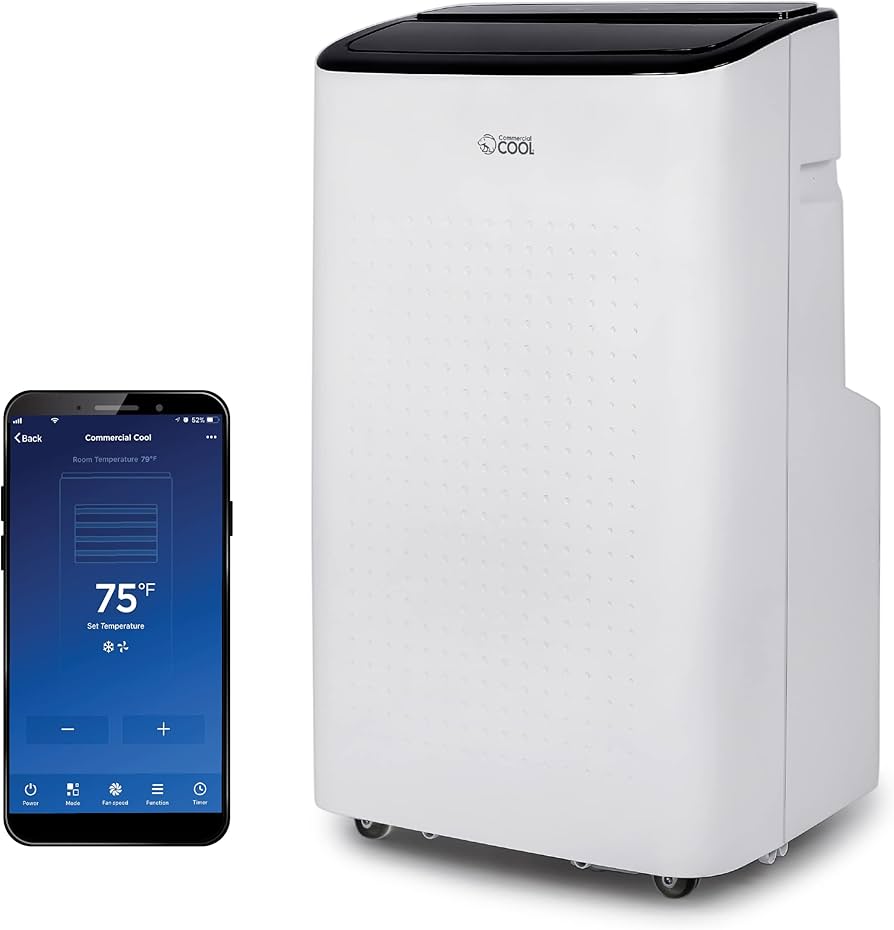
Recent commercial cool portable air conditioner models increasingly incorporate smart technology features that enhance convenience and efficiency through smartphone connectivity and voice control integration. While basic models rely on manual controls and simple remotes, mid-range and premium options may include WiFi connectivity enabling temperature adjustments, scheduling, and monitoring through dedicated mobile applications. Some units integrate with popular smart home ecosystems like Amazon Alexa and Google Assistant, allowing voice commands like “Alexa, set the portable AC to 74 degrees.”

These smart features prove particularly valuable for remote control—adjusting temperatures before arriving home, receiving alerts when filters need cleaning, or monitoring energy consumption through detailed usage reports. However, smart features typically add $50-$150 to purchase prices and require stable WiFi networks, making them worthwhile primarily for tech-enthusiast users who value convenience over basic functionality.

Noise Levels and Sleep Considerations

Understanding noise characteristics helps set realistic expectations when purchasing a commercial cool portable air conditioner for bedroom or office use. Portable AC units generate sound from three primary sources: compressor operation (the refrigeration cycle that actually cools the air), fan motors that circulate air through the unit, and air movement through intake and exhaust vents. Commercial Cool models typically produce 52-56 decibels during normal cooling operation, comparable to moderate rainfall or normal conversation levels. Sleep mode functions on many models reduce fan speeds during nighttime hours, lowering noise output to 45-48 decibels while gradually adjusting temperatures for comfortable sleeping.

For noise-sensitive individuals, consider positioning the unit at least 8-10 feet from sleeping or work areas, using white noise machines or fans to mask operating sounds, or selecting premium models with noise-reduction engineering that achieve sub-50 decibel operation.

Warranty Coverage and Customer Support

Protecting your investment requires understanding the warranty terms and customer support resources available for your commercial cool portable air conditioner. Standard Commercial Cool warranty coverage spans one year from purchase date for both parts and labor, protecting against manufacturing defects and component failures under normal use conditions. Warranty claims typically require proof of purchase from authorized retailers, proper installation following manufacturer guidelines, and regular maintenance including filter cleaning. The warranty explicitly excludes damage from misuse, unauthorized modifications, improper voltage, or lack of maintenance.

Extended warranty options purchased through retailers add 1-3 additional years of coverage for $40-$100, potentially worthwhile for commercial applications or users lacking technical skills for minor repairs. Customer support resources include phone support during business hours, email assistance with 24-48 hour response times, and online troubleshooting guides addressing common issues.

Suggested read: Everstar Portable Air Conditioner: Your Complete Solution for Staying Cool Anywhere

Professional Installation vs. DIY Setup

Most commercial cool portable air conditioner buyers successfully complete installation without professional assistance, though certain situations warrant expert help. DIY installation works well for standard applications involving typical sliding windows, adequate electrical circuits, and users comfortable with basic assembly tasks. Professional installation becomes advisable for challenging situations including casement windows requiring custom adapters, older buildings with inadequate electrical infrastructure, commercial applications demanding optimal efficiency and code compliance, or users with physical limitations preventing safe unit handling.

Professional installation costs typically range from $100-$250 depending on complexity and regional labor rates, adding 20-40% to overall project costs. However, proper professional installation ensures warranty compliance, optimal performance, and safe electrical connections, potentially preventing costly problems and efficiency losses that erode the DIY savings advantage.

Seasonal Storage and Off-Season Protection

Properly storing your commercial cool portable air conditioner during off-season months protects your investment and ensures reliable performance when cooling season returns. Begin end-of-season preparation by running the unit in fan-only mode for 2-3 hours to thoroughly dry internal components, preventing mold and mildew growth during storage. Clean air filters completely and allow them to dry thoroughly before reinstalling, as damp filters create musty odors and promote bacterial growth. Drain all water from condensate tanks and internal reservoirs, then disconnect and clean the exhaust hose separately.

Store the unit in climate-controlled indoor spaces like basements or closets rather than hot attics or humid garages where temperature extremes and moisture accelerate component degradation. Cover the unit with breathable fabric covers that protect from dust while allowing air circulation, avoiding plastic tarps that trap moisture and promote corrosion.

Health Benefits and Air Quality Improvements

Beyond temperature regulation, commercial cool portable air conditioner units provide secondary health and comfort benefits through dehumidification and air filtration. The cooling process naturally removes moisture from indoor air, reducing humidity levels that promote mold growth, dust mite populations, and musty odors while creating more comfortable perceived temperatures. Maintaining indoor humidity between 30-50% alleviates respiratory discomfort, reduces allergy symptoms, and protects wood furniture and flooring from moisture damage. Built-in air filters capture dust, pollen, pet dander, and other airborne particles, improving air quality for allergy and asthma sufferers.

For maximum health benefits, clean or replace filters weekly during heavy use, maintain proper humidity levels, and ensure adequate ventilation to prevent stale air accumulation. Consider units with HEPA or activated carbon filters for enhanced particle and odor removal, though these premium filtration systems typically cost $50-$100 more than standard filters.

Making Your Final Purchase Decision

Selecting the ideal commercial cool portable air conditioner requires balancing cooling requirements, budget constraints, feature preferences, and space limitations through systematic evaluation. Begin by accurately measuring your room dimensions and calculating appropriate BTU requirements using the guidelines provided earlier, adding 10-20% capacity for challenging conditions. Establish your budget range considering not just purchase price but also operating costs, with more efficient models potentially offsetting higher initial investments through reduced electricity consumption. Prioritize features that match your specific needs—remote controls and timers provide convenience, while multi-mode operation extends usability beyond cooling season.

Read verified customer reviews from multiple sources to identify consistent performance patterns and potential issues, focusing on reviewers with similar applications and room sizes. Finally, purchase from authorized retailers offering solid return policies, allowing you to test the unit in your actual space and return if performance disappoints.

Take Action: Stay Cool This Summer

Don’t suffer through another sweltering summer—invest in a commercial cool portable air conditioner that delivers reliable, affordable cooling for your home or office. With flexible placement options, straightforward installation, and effective temperature control, these units provide immediate relief without expensive HVAC upgrades or permanent installations. Visit your local home improvement retailer or browse online selections to compare models, read detailed specifications, and find the perfect unit for your cooling needs. Take advantage of seasonal sales and promotional pricing to maximize your investment. Order your commercial cool portable air conditioner today and transform your hottest rooms into comfortable, climate-controlled spaces you’ll actually want to spend time in throughout the warmest months.

Frequently Asked Questions About Commercial Cool Portable Air Conditioners

Q: How much electricity does a commercial cool portable air conditioner use?

A: A typical 10,000 BTU Commercial Cool portable air conditioner consumes approximately 900-1,200 watts per hour during active cooling, translating to $0.11-$0.14 per hour based on average electricity rates. Running the unit 8 hours daily costs roughly $0.88-$1.12 per day or $26-$34 monthly during peak summer use.

Q: Can I use a commercial cool portable air conditioner without venting it outside?

A: No, portable air conditioners must vent hot exhaust air outside to function properly. Operating without proper venting causes the unit to recirculate hot air, negating cooling effects while potentially damaging internal components through excessive heat buildup. Always install the exhaust hose according to manufacturer instructions.

Suggested read: GE Portable A/C: Your Complete 2025 Buying Guide for Cooling Any Space

Q: How often should I drain the water from my portable AC unit?

A: Drainage frequency depends on humidity levels and usage patterns. In humid climates, condensate tanks may fill every 8-12 hours during continuous operation. Check the tank daily during initial use to determine your specific drainage schedule, or install the continuous drain hose for automatic gravity-fed drainage.

Q: What size room can a 10,000 BTU commercial cool portable air conditioner cool effectively?

A: A 10,000 BTU unit effectively cools rooms between 250-350 square feet with standard 8-foot ceilings, average insulation, and moderate sun exposure. Adjust expectations downward for poorly insulated spaces, rooms with high ceilings, or areas with significant heat sources like large windows or multiple electronics.

Q: Are commercial cool portable air conditioners loud during operation?

A: Commercial Cool units typically produce 52-56 decibels during normal cooling operation, comparable to moderate conversation or light rainfall. Sleep mode reduces noise to approximately 45-48 decibels by lowering fan speeds. Noise sensitivity varies individually—some users find this acceptable while others prefer quieter environments.

Q: How long do commercial cool portable air conditioners typically last?

A: With proper maintenance including regular filter cleaning and seasonal storage, Commercial Cool portable air conditioners typically last 5-7 years. Some well-maintained units continue operating effectively for 8-10 years, though efficiency may decline gradually over time. Commercial applications with heavier usage patterns may experience shorter lifespans.

Q: Can I run my commercial cool portable air conditioner 24/7?

A: While portable air conditioners can technically operate continuously, 24/7 operation significantly increases energy costs and accelerates component wear. Use programmable timers to cycle the unit on and off, maintaining comfortable temperatures while reducing runtime. Most users find 8-12 hours daily operation sufficient for comfort.

Q: Do commercial cool portable air conditioners require professional maintenance?

A: Routine maintenance tasks including filter cleaning, water drainage, and exterior cleaning require no professional assistance. Annual professional inspection may prove worthwhile for commercial applications or units showing performance decline, particularly for refrigerant level checks and compressor evaluation.


Sources and Citations:

  1. Energy efficiency and BTU calculations based on Department of Energy residential cooling guidelines and ENERGY STAR portable air conditioner specifications
  2. Pricing information compiled from Home Depot, Lowe’s, Amazon, and Walmart online catalogs (November 2025)
  3. Consumer review aggregation from verified purchases across major retail platforms
  4. Environmental refrigerant information from EPA guidelines on ozone-friendly cooling substances
  5. Commercial Cool product specifications from manufacturer documentation and retail product listings