
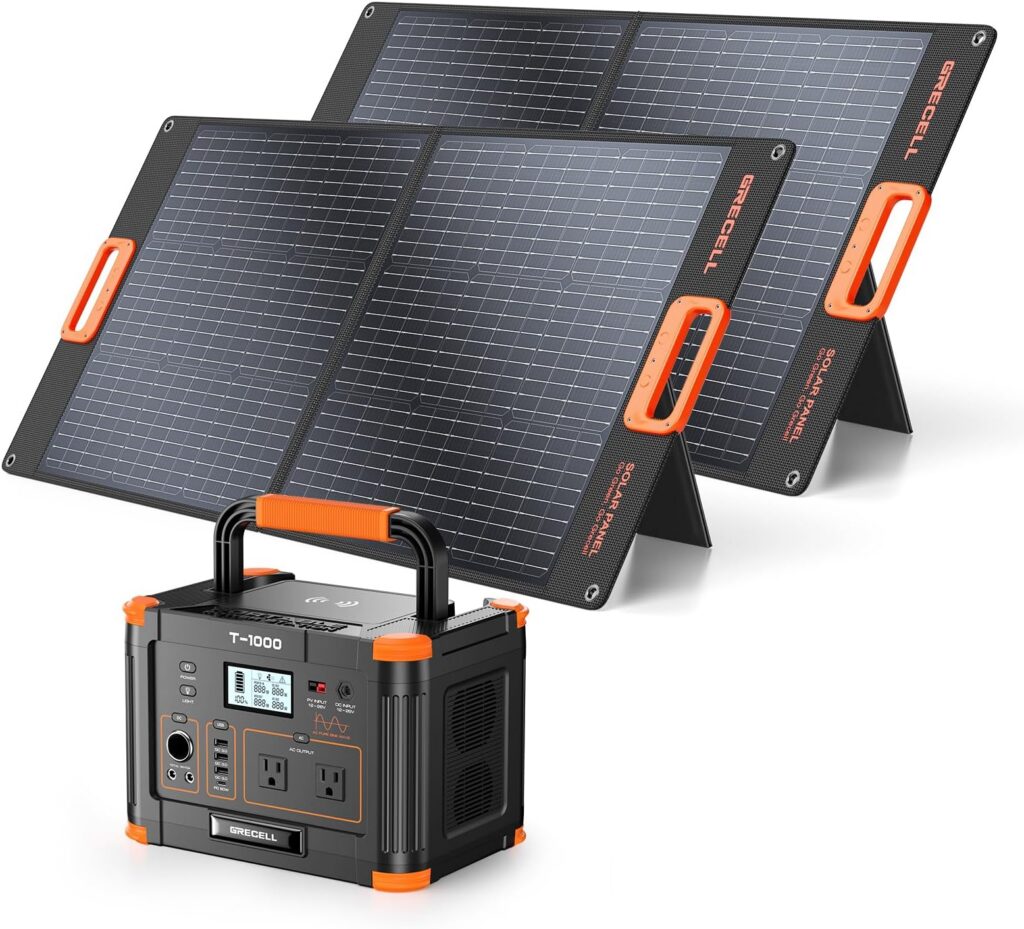
How Many Solar Panels to Charge a Portable Power Station for Home Backup
The short answer: it depends on how much energy you need, how many hours of sun you get, and what your power station is designed to accept. There is no single “right number” of panels for every setup. But there are practical rules of thumb that work well for home backup in the United States. For most people, the realistic goal is not to recharge a large station from empty every day. It is to top off the battery each day with enough solar power to cover the critical loads you actually use during an outage. That distinction makes the answer much clearer. [1]
Start with Your Power Station’s Capacity
Portable power stations are rated in watt-hours (Wh). This tells you how much energy the battery can store. A 1,000Wh station can run a 60W laptop for more than 16 hours, while a 2,000Wh station is better suited for microwaves, power tools, or a partial home backup setup. [6]
The larger the station, the more solar you need to recharge it efficiently. [6]
Here is a quick reference based on the recommendations from the sources above:
| Power Station Capacity | Recommended Solar Array | Notes | |—|—|—| | 300Wh or less | 100W | A 100W panel is the only realistic option at this size | | 1,000–2,000Wh | 200W panel(s), with a second 200W added if you need more charging | 100W panels are impractical for stations above 1,000Wh | | 2,000Wh | 400–500W | This helps you stay ahead of daily consumption | | 2,400Wh for home backup | 400–600W | Supports daily recharge for essentials like routers, lights, and CPAP machines | [1][2]
For reference, solar panels commonly come in 100W, 200W, and 400W sizes. So a 400–500W recommendation could mean two 200W panels, or one 400W panel plus a small additional panel. [6]
Top-Off vs. Full Recharge
The biggest mistake people make is assuming every panel setup has to take a station from 0% to 100% in one day. That is rarely necessary for home backup. A more practical approach is to top off the charge each day rather than provide a full 100% recharge. In fact, the GearLab team notes that for a 1,000–2,000Wh station, a single 200W panel will often be enough for that daily top-off. If you need more solar charging, add a second 200W panel. [1]
But if you are using a lower-capacity station, the math is different. For a 500Wh station with a 100W panel, you can recharge in about 5–7 hours of direct sunlight. For an 800Wh station, two 200W panels can recharge it in roughly 3–5 hours under optimal conditions. [6]
What “Home Backup” Really Means in Practice
When people search for solar panels to charge a power station for home backup, they often imagine running a normal household during an outage. That expectation is usually too high. Even someone with a large-scale home backup system—a 45-panel rooftop solar array plus a 20kWh power station system—found that it did not provide enough power for a 24-hour power outage during winter unless he turned off the breakers for all non-essential circuits. That system is far bigger than any portable power station. If that setup cannot run a normal whole-home load through a winter outage, a portable station with a few panels will not either. [1]
So the actionable advice is simple: plan for critical circuits, not the whole house. A portable power station plus solar panels is a practical way to run a refrigerator, a router, a CPAP machine, a few lights, and phone chargers. It is not a realistic replacement for your electric water heater, HVAC system, or stove. [1]
The 2,000Wh Home Backup Example
If you have a 2,000Wh battery, one source recommends aiming for 400–500 watts of solar panels to stay ahead of your daily consumption. That is roughly two or three 200W panels depending on the exact panel sizes you choose. [2]
This is more aggressive than the “one 200W panel” recommendation above. Why? Because they are solving different problems: [2]
- One 200W panel is the practical choice for topping off a 1,000–2,000Wh station. – 400–500W is the better target if you want to stay ahead of daily consumption on a 2,000Wh station. [1][2]
For home backup, you should be closer to the 400–500W end unless your power use is very light.
Larger Stations Need a Larger Array [6]
If you have a large portable power station, you need to think in terms of total solar input, not just panel count. For example, the Delta Pro accepts up to 1,600 watts of solar input. The manufacturer lists it with two 220W panels, but in practice, with only those two panels, you likely won’t be able to recharge fully in one day under significant loads. Under heavy use, two 220W panels will merely extend the station’s run time rather than bring it back to full. [3]
To get closer to a full recharge in one day, you need to connect more solar panels. In that case, getting close to the 1,600W input limit can reduce charge times nearly fourfold. [3]
That requires space. If you are using the station for home backup, you probably have room for multiple rigid or portable panels. But if you are using it in a camper or for travel, space may be more limited.
may not Exceed the Maximum Solar Input
Every power station has a maximum solar input rating. You can connect a solar array with equal or lower-rated power, but you should may not exceed the generation capacity specified by the manufacturer. [5]
So if your station’s max solar input is 800W, don’t connect 1,000W of panels just to try to charge faster. The station is not designed for that. This also means that “more panels is often better” is false. The right number is the number that: [5]
- Matches your station’s capacity and your daily energy needs, and
- Stays within the station’s max solar input limit. [5]
How to Size Your Solar Array for Home Backup
Here is a practical step-by-step approach that uses the guidance above.
Step 1: Identify your station’s capacity in watt-hours [6]
Check the model name and capacity on the station’s label or manufacturer listing. For a home backup station, you are likely looking at 1,000Wh or higher.
Step 2: Decide how much energy you need per day [1][2]
If your goal is to run a fridge, router, CPAP, and a few lights during an outage, you may only need a fraction of the station’s capacity each day. That makes a smaller array more practical. If you want the station to be ready for a full day’s use every day, you need enough solar to recharge that amount every sunny day.
Step 3: Use the capacity-to-panel rule as a starting point [6]
For a 2,000Wh station, aim for 400–500W of solar. [2]
For a 2,400Wh station used for home backup, 400–600W is a reasonable range. [6]
For a 1,000–2,000Wh station where you only need a top-off, start with one 200W panel and add a second if you find you need more. [1]
Step 4: Account for sunlight hours in your area
Your location matters. The number of hours of sunlight available in your area is one of the key factors in choosing the right panel size. Less sun means you need more wattage, and more sun means you can get away with less. [6]
Step 5: Check the station’s max solar input
Once you have a target wattage, compare it to the station’s maximum solar input rating. If your target is 500W but the station only accepts 400W, you are limited to 400W unless you are using a different station.
What Else to Check Before Buying Solar Panels [5]
Connector and Compatibility
Panel connectors differ between brands. Before ordering, check the station’s solar input port and connector type. The manufacturer’s current listing is the a strong option place to verify that the panels you are considering will plug in and work with your station.
Model-Year Specs Change
Capacity, max solar input, and bundled panel choices change from model year to model year. The products mentioned in this guide are examples from current sources, but they are not may help that the same specs will be available when you shop. Check the current manufacturer or retailer listing for the exact specs and package contents.
Real-World Output Is Lower Than Rated Output
A “200W” panel does not often produce 200W in real-world conditions. Clouds, panel angle, temperature, and shade all affect output. That is why the recommendations above allow some flexibility—for example, using two 200W panels for a 1,000Wh station to ensure a steady recharge even when conditions are not ideal. [6]
Balanced Recommendation for US Home Backup
If you are setting up a portable power station for home backup, here is a balanced starting point:
- For a 1,000–2,000Wh station: start with one 200W panel and add a second if your daily needs require more. – For a 2,000Wh station: plan for 400–500W of panels if you want to stay ahead of daily consumption. – For a 2,400Wh station: 400–600W is a practical range for daily recharge. – For a large 3,600Wh station: you will need a much bigger array. Getting close to the station’s max solar input can reduce recharge time significantly. [1][2]
Above all, set realistic expectations. A portable power station plus solar panels is an excellent way to keep essential devices running during an outage. It is not a whole-home backup system unless you are willing to turn off non-essential circuits and use critical loads only. [1]
Before you buy anything, verify the exact capacity, max solar input, and connector compatibility on the current manufacturer or retailer listing. Specs change, and a number from last year’s model may not apply to this year’s version.
Sources
1. [The a strong option Power Stations of 2026 | Lab Tested & Ranked](https://www.outdoorgearlab.com/topics/camping-and-hiking/a strong option-power-station) 2. Building a Reliable Home Backup System 3. [The 8 a strong option Solar Generators of 2026—a strong option Portable Power …](https://www.popularmechanics.com/adventure/outdoors/a37295464/a strong option-solar-powered-generators) 4. Solar Generators | Clean, Reliable, Portable Power for You 5. Portable Power Stations: How to Choose & 3 Reputable Brands 6. How Big of a Solar Panel is Necessary for a Power Station?
This Post Has 3 Comments