
How to Calculate Portable Power Station Size for Home Backup
Portable power stations are sized by two different numbers: how much power they can deliver at one moment (measured in watts) and how much energy they can store (measured in watt-hours). For home backup, you need both numbers to match your critical appliances and the length of the outage you expect to ride out. Before you shop, build a device list, calculate your watt-hour needs, apply an efficiency factor, and check whether the station can handle startup surges. Here is the step-by-step process.
Why volts, watts, and watt-hours all matter [1][5]
Voltage determines whether a power station is electrically compatible with an appliance. Most portable devices use 120V power, while some larger appliances and home-backup loads require 240V. Output wattage determines what the power station can run at one time. Battery capacity in watt-hours (Wh) helps determine how long it can run those devices. Surge capacity matters for devices with motors or compressors, such as refrigerators, sump pumps, air conditioners, and some tools. [1]
Watts and watt-hours are not interchangeable. A kilowatt is 1,000 watts, and it tracks instantaneous power usage. A kilowatt-hour measures power usage over a full hour. Because household appliances constantly cycle on and off, their actual daily drain is measured in kilowatt-hours. Mixing up these terms can cause severe mistakes when planning a home backup system. [3]
Step 1: List what you want to power
Start by listing the devices and appliances you want to run with your portable power station. For home backup, focus on the essentials. For essential home backup, such as refrigerators, sump pumps, CPAP machines, or medical equipment, you will need a higher-capacity model with a stronger inverter. [1][3]
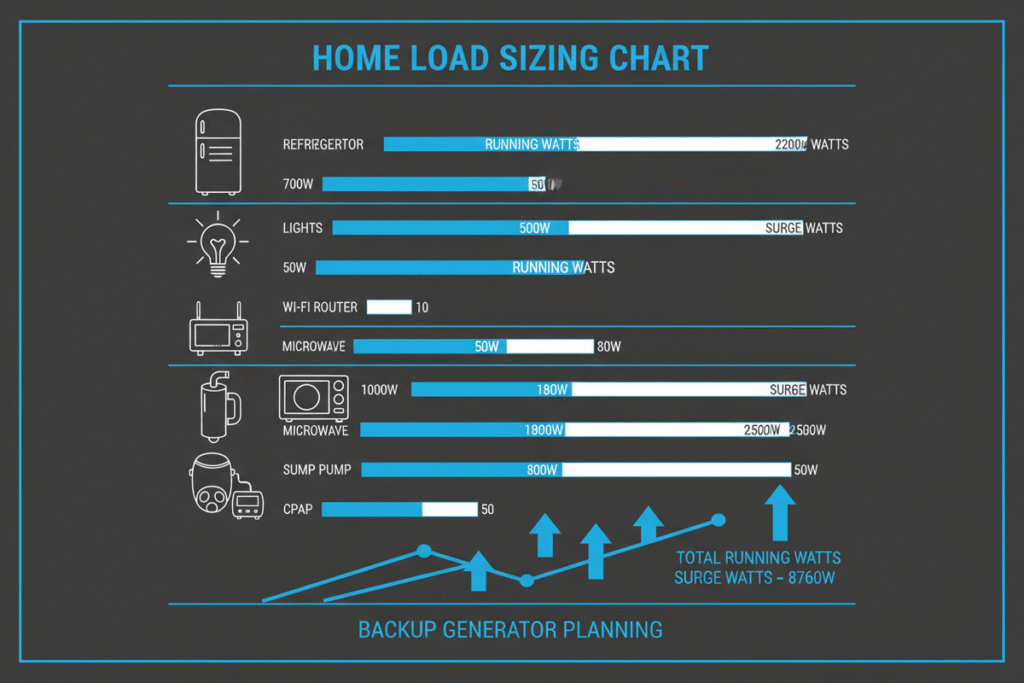
Here are typical power draws for common devices. Actual power consumption varies by model and usage. [5]
| Device | Typical Power Draw | |—|—| | Smartphone | 5–20W | | Laptop | 45–100W | | LED camping light | 5–15W | | Portable fan | 20–50W | | CPAP machine | 30–60W | | Portable refrigerator | 40–70W | | Coffee maker | 600–1000W | | Microwave | 800–1500W | [5]
For a home refrigerator, the numbers look different because of the compressor. Check both running wattage and compressor startup demand. A refrigerator that averages 100–200W may briefly require much more power when the compressor starts. Compressor refrigerators cycle on and off, so they do not draw power continuously. [4][5]
Step 2: Calculate your watt-hour needs
The core formula is simple:
Energy (Wh) = Power (W) × Runtime (hours) [5]
Multiply the watts used by each device by the number of hours you expect to use it, then add those watt-hour totals together. [1]
Example: Daily energy estimate
One sizing guide uses a basic example: [5]
| Device | Power | Runtime | Energy Used | |—|—|—|—| | Laptop | 60W | 3 hours | 180Wh | | Portable refrigerator | 50W | 8 hours | 400Wh | | LED light | 10W | 5 hours | 50Wh | | Phone charging | 15W | 2 hours | 30Wh | [5]
Total estimated daily energy use is about 660Wh. To account for conversion losses and unexpected usage, that guide recommends an 800–1000Wh portable power station for a more comfortable margin. [5]
Add an efficiency factor
For AC-powered devices, divide the total by an efficiency factor such as 0.85 for a reasonable planning estimate. This compensates for energy inefficiencies and reflects the minimal amount of power the station can produce. [1][2]
Applying the 0.85 factor to the 660Wh example gives about 776Wh. Adding reserve capacity moves you into the same 800–1000Wh range. The exact factor is a planning tool, not a hard spec. [5]
To estimate runtime on a specific station, use this formula: [3][4]
Runtime = capacity (Wh) × efficiency factor ÷ load watts [3][4]
Many guides use 0.85 as the standard efficiency factor for power conversion. Some manufacturers suggest 0.90 for conservative planning. Actual runtime varies with temperature, appliance cycling, standby consumption, and inverter efficiency, so treat the result as an estimate. [3][4]
Step 3: Check output wattage and surge before capacity
Battery capacity tells you how long a portable power station can run your devices, but output power determines what devices it can run. You can have enough stored energy and still not be able to start a motor-driven appliance. [5]
Surge capacity matters for devices with motors or compressors, such as refrigerators, sump pumps, and air conditioners. A refrigerator that averages 100–200W may require much more power for a brief moment when the compressor starts. often check continuous wattage, startup wattage, voltage, and plug type before connecting an appliance. [1][4]
Voltage is also part of the compatibility check. Most portable devices use 120V power, while some larger appliances and home-backup loads require 240V. If your home backup plan includes a 240V appliance, verify the power station’s output voltage and the appliance’s rating before connecting anything. [1]
Step 4: Use capacity ranges as a sanity check
Capacity ranges give you a starting point, but they are not a replacement for your own list and math. – Small portable power stations (100–500Wh) are a strong option for phones, tablets, laptops, cameras, lights, routers, and very light-duty use. They are not ideal for large appliances. – Medium portable power stations (500–1500Wh) are a strong option for CPAP machines, TVs, routers, laptops, small refrigerators, lights, and some kitchen devices. They can handle more meaningful loads without becoming too large. – For light emergency use, a compact power station around 300Wh to 600Wh is ideal for charging phones, running a laptop, powering small lights, or keeping a Wi-Fi router online for several hours. – For home backup and emergency preparedness, a common starting point is 2000Wh or more. [1][3]
You may see conflicting advice. One guide calls 500–2000Wh an ideal spot for portable power stations. Another recommends 2000Wh+ specifically for home backup. The difference is the load. If your emergency plan is a lamp and a phone charger, a 500Wh unit can work. If you need a refrigerator and a CPAP machine overnight, start with 2000Wh and add reserve. [2][5]
If all you need is phones charged and a few LED lamps lit for 3–4 hours at a time, a small station of not more than 150Wh may be suitable. At the other end, if you need to run heavier appliances, some guides point toward power stations in the 4000–5000Wh range. The right size is determined by your specific loads and your target outage duration, not by a universal number. [2]
Worked example for a short overnight outage
Suppose you want to keep the essentials running for one night:
To estimate your energy needs, list each device's wattage and expected runtime, then multiply to get watt-hours. For example, a refrigerator may average 100–200W, a CPAP machine 30–60W, and LED lights 5–15W. Use the formula: Energy (Wh) = Power (W) × Runtime (hours). Add the totals and divide by 0.85 to account for efficiency losses. [1][3][5]
Total: 1,300Wh. Divide by 0.85 for conversion losses: about 1,529Wh. Add a reserve margin, and a 1,600–2,000Wh station is a reasonable starting point. This is an example, not a recommendation for every home. Use the wattage on your actual device nameplates and your own target runtime.
Practical limitations to plan around [1][2]
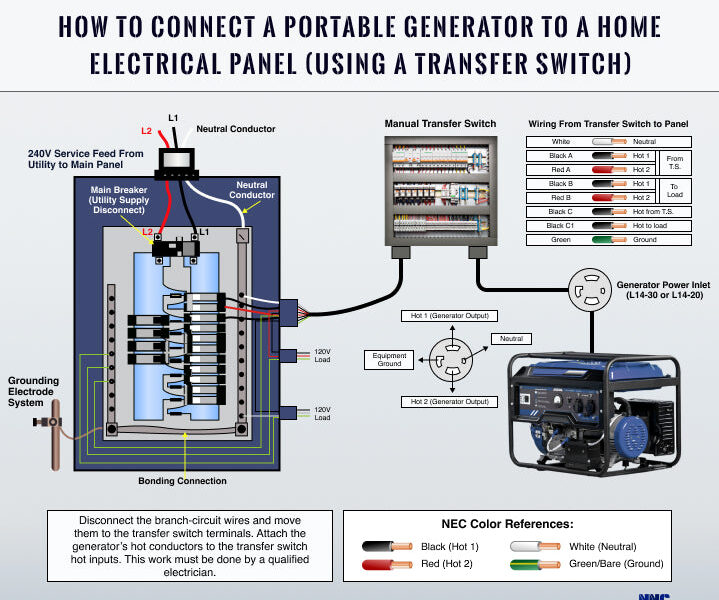
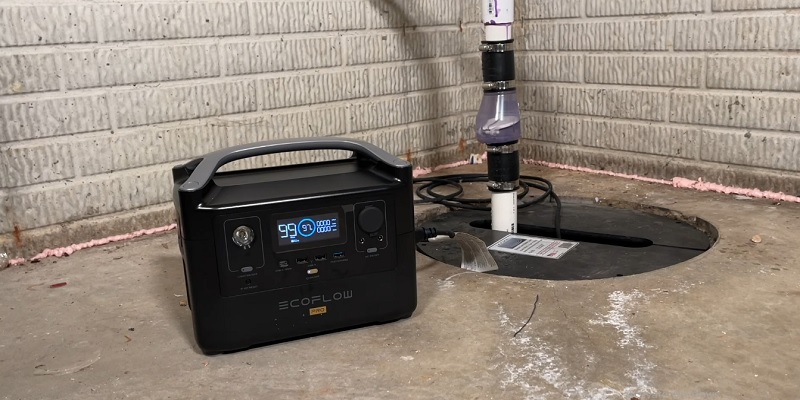
Portable power stations are versatile, but they are not a permanent whole-home solution. A large portable power station can handle many 120V household appliances, but it should not be confused with a permanently installed whole-home battery system. If your backup plan includes a transfer switch, a 240V well pump, or a whole-home load, verify compatibility with the manufacturer before relying on it. [4]
Runtime will vary in real-world conditions. Actual runtime depends on temperature, appliance cycling, standby consumption, and inverter efficiency. A station rated for a certain capacity may not deliver that full amount for every load. [4]
For CPAP use, confirm whether the quoted wattage includes the humidifier and heated hose. Disabling heat functions can substantially extend runtime, but you should follow your medical provider’s instructions. DC operation may reduce conversion losses when the correct manufacturer-approved adapter is available. [4]
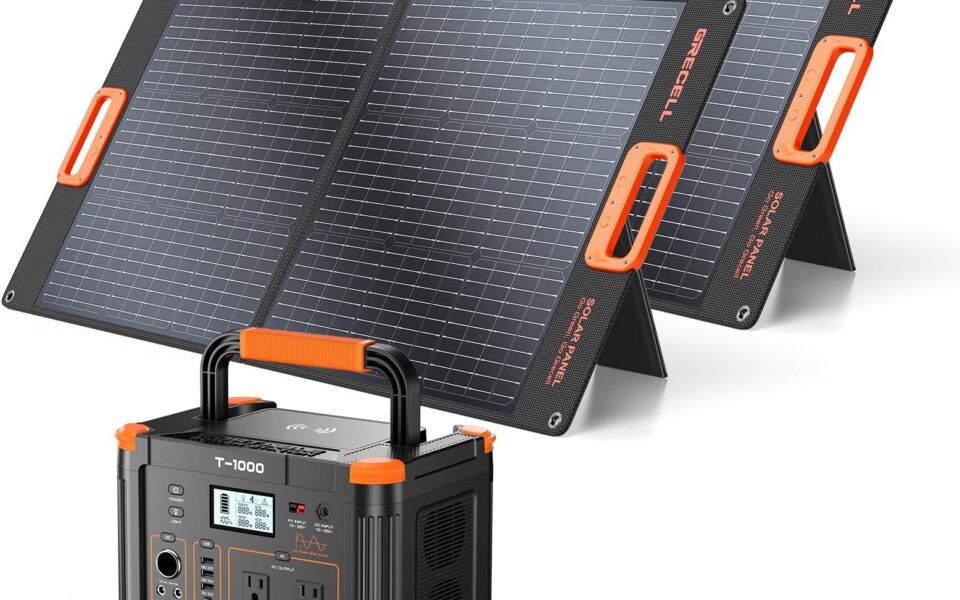
If you plan to recharge with solar, build that into your plan. Some retailers offer interactive calculators that let you add appliances, choose a charging strategy, and select days of backup power. A calculator can also estimate the solar array size based on peak sun hours. Verify the station’s maximum solar input from the current manufacturer listing. [6]
Before buying, check the current manufacturer or retailer listing for exact capacity, output wattage, battery chemistry, weight, charging options, and included accessories. Pricing, stock, discounts, ratings, shipping availability, package contents, compatibility, and model-year details change over time, so confirm before purchase.
1. How to Select the Right Size Portable Power Station For Your Needs 2. How Do I Know What Size Portable Power Station I Need? – BLUETTI US 3. Portable Power Station Calculator: Find Your Perfect Size – Anker SOLIX 4. a strong option American-Made Portable Power Stations in 2026 5. What Size Portable Power Station Do I Need? – VTOMAN 6. Portable Power Station Size Calculator – PowerGen Store
This Post Has 4 Comments