
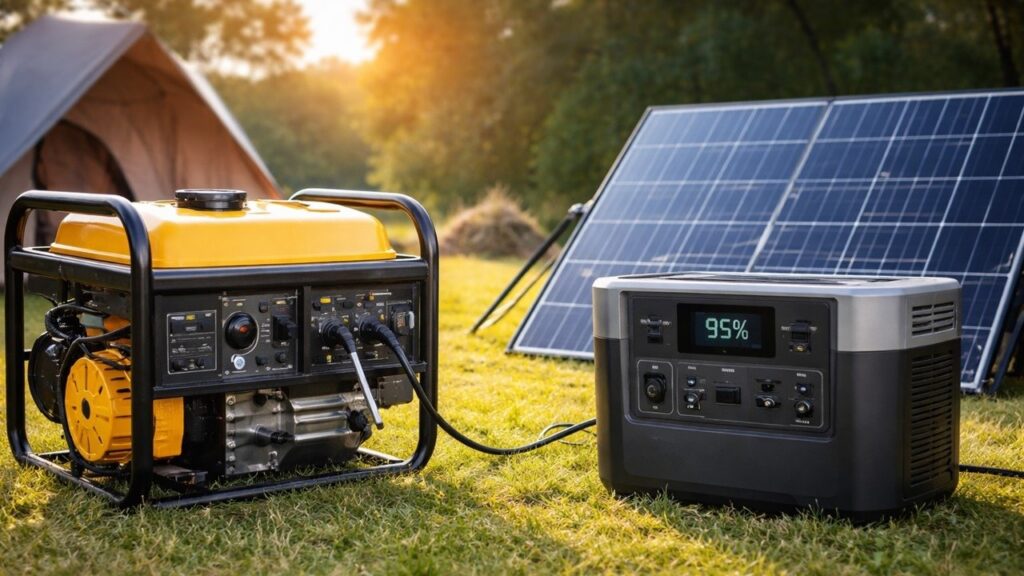
Portable Power Station vs Generator for Home Backup: What to Know Before Your Next Outage
Over the past decade, the average U.S. outage duration rose 181% — from 236 minutes per customer in 2014 to 662 minutes in 2024, according to the U.S. Energy Information Administration. That longer gap between grid failures has pushed more households to think seriously about backup power. [1]
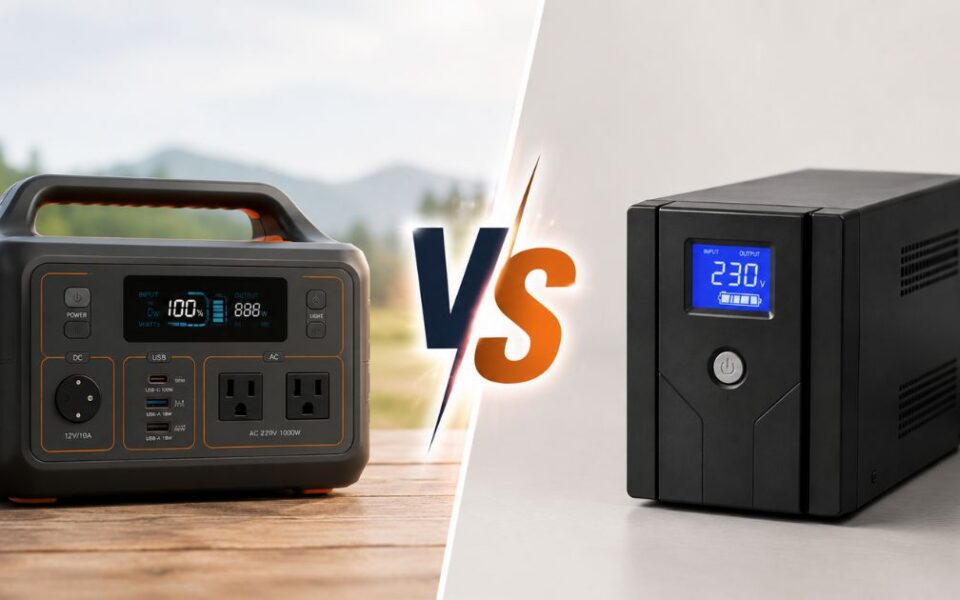
The two most common options solve the problem in very different ways. A portable power station stores energy in a battery and releases it on demand. A generator creates power on demand by burning fuel such as gasoline, propane, or diesel. Both will keep your fridge running, but they have very different limits. [3]
Here’s what you need to know before you buy.
Power Output: What Can Each One Actually Run?
Gas generators are built around combustion engines, and their output range is wide: from 1,000 W to 20,000 W of continuous power. A midsize portable inverter model such as the Honda EU2200i delivers 2,200 W peak and 1,800 W continuous, at 48 to 57 dB. At the top end, a standby unit like the Generac Guardian 22kW delivers 22,000 W continuously and can power an entire home automatically when the grid drops. [1]
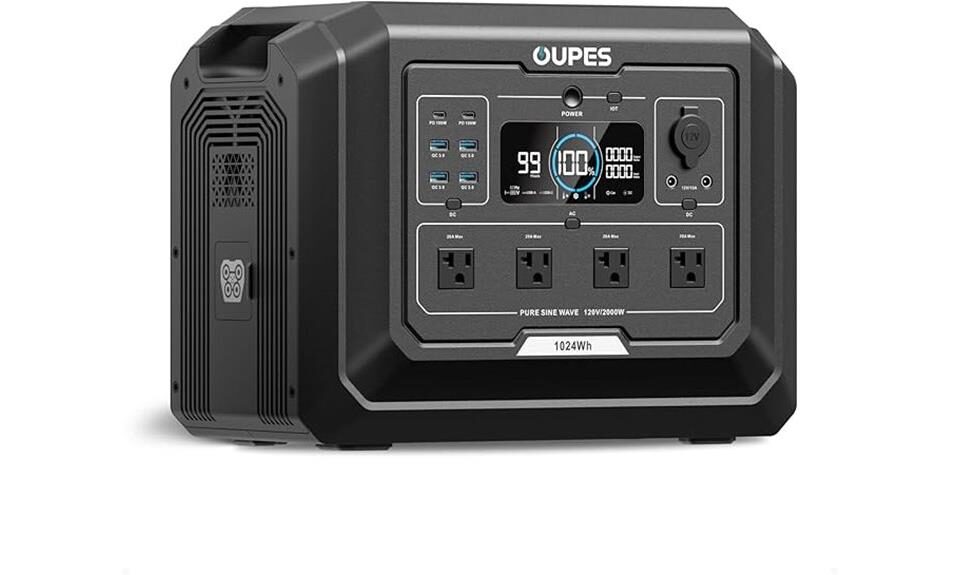
Portable power stations typically top out between 3,000 W and 6,000 W. The Anker Solix F3800 Plus, for instance, reaches 6,000 W of output, which can handle a refrigerator, router, lighting, and a window air conditioner at the same time. What it can’t do is sustain a central HVAC system, an electric water heater, or a well pump — those loads tend to need 3,000 W to 5,000 W of continuous draw, and sometimes more. [1]
That output ceiling matters a lot for whole-home backup. Average U.S. households use roughly 886–900 kWh per month, which works out to around 30 kWh per day. Full-house, multi-day backup requires substantial storage, not just peak wattage. For most families, backing up critical circuits — fridge, lights, Wi-Fi, phones, and some medical or work gear — is more practical than trying to power everything. [6]
A portable power station can replace a gas generator for most short outages if your load is limited to a refrigerator, lighting, a router, and charging devices. It can’t replace a gas generator for loads requiring 5,000 W or more, like a central HVAC system, or for outages lasting more than two to three days without reliable solar recharging. [1]
If you’re unsure what an appliance draws, check the nameplate on the device or use a plug-in watt meter. That small step will save you from buying a unit that’s too small.
Runtime and Refueling: The Biggest Trade-Off
A generator can run as long as you have fuel, and refueling is easy. A portable power station runs on stored battery energy; once it’s empty, you need to find another power source to recharge it, which takes time. That’s a practical problem during an outage, because you have to plug the station into an outlet to recharge, and outlets don’t work when the power is off. Reliable solar recharging changes that equation, but only if the conditions are right. [5][2]
Here’s the kind of math that matters for planning. Using the common 80% usable-capacity rule, a 3 kWh portable power station delivers about 2,400 Wh. If your critical loads consume 400 W on average, the runtime is roughly 2,400 Wh ÷ 400 W, or about 6 hours. [6]
That example shows why capacity math matters more than headline run-time claims. Manufacturer run-time figures are not consistently tested, so use the capacity-and-wattage method as your planning baseline, and verify the model’s current specifications on the manufacturer’s page before you buy.
Safety and Placement: Indoor vs. Outdoor
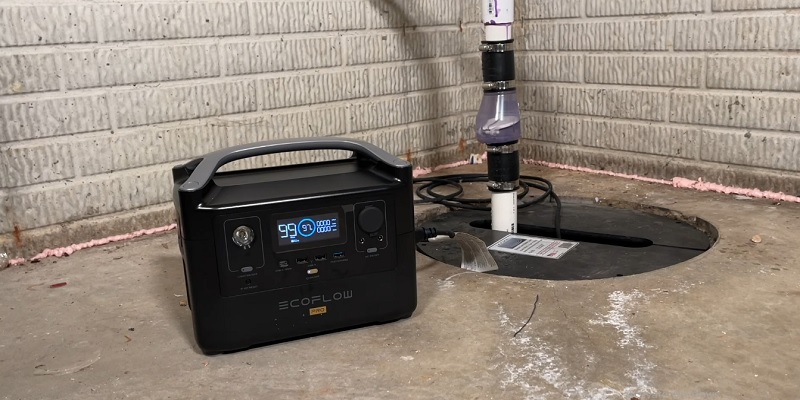
A portable power station doesn’t emit dangerous carbon monoxide fumes. That means it doesn’t require the safety precautions of a generator: outdoor placement, at least 20 feet from a home or garage, with the exhaust directed away from windows, doors, and air conditioners. You can run a power station in your kitchen, basement, or garage. This makes a battery station a compelling alternative for apartment dwellers who want emergency backup power but lack the outdoor space to run a generator. [2]
A fuel generator is a different story. It produces exhaust, carries a carbon monoxide risk, and requires outdoor use only. If you choose a generator, plan for that safety distance and never run it near openings into the home. [6][2]
Noise: The Nighttime Difference
Portable power stations are significantly quieter, often producing only low fan noise (under 40 dB) under moderate load. Even a generator marketed as “quiet” is louder than that; the Honda EU2200i, for example, runs at 48 to 57 dB. If you’ll need power while people are sleeping — or if your backup has to sit near a neighbor’s window — that difference is significant. [4][1]
Power stations also remove the regular maintenance burden that comes with combustion: no messy gasoline refills or clogged carburetors. [2]
Cost, Weight, and Maintenance
Portable power stations can be pricey and weighty. On a per-kilowatt-hour basis, the upfront cost is generally higher than for a fuel generator. That cost buys you quiet operation, placement flexibility, no on-site emissions, and no gasoline to store. [2][6]
Generators have their own ongoing costs. Fuel storage, refueling, and general upkeep are part of ownership. Think about how often you’ll actually use the unit and how hard it will be to maintain readiness year after year. [6]
Prices, stock, discounts, package contents, and model-year details change frequently, so always check the current manufacturer or retailer listing before making a purchase decision.
How to Choose for Your Home
1. List your critical loads
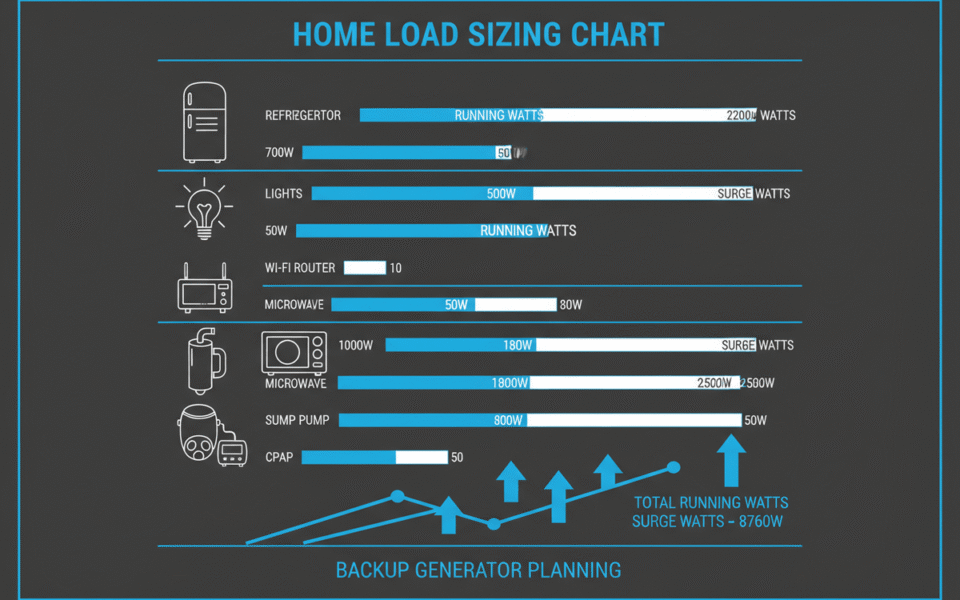
Start with what must run during an outage. For many households that’s a refrigerator, lighting, Wi-Fi, phones, and perhaps a window air conditioner or a piece of medical equipment. Write down each item and its wattage. [1][6]
2. Match the output, not just the battery size
If any single item — or the combined set — requires 3,000 W to 5,000 W continuously, a portable power station may not be enough. Look for a system with high continuous AC output that can sustain your heaviest load. [1][6]
3. Decide your target runtime
If you expect outages longer than two to three days and you don’t have reliable solar recharging, a battery-only approach becomes risky. A generator can keep running as long as you have fuel. [1][5]
4. Consider where you can safely run it
If you live in an apartment or a home without a safe outdoor placement option, a power station is the safer choice because it can run indoors. If you have an outdoor space and need heavy loads, a generator is more flexible. [2]
5. For whole-home backup, look beyond a single portable unit
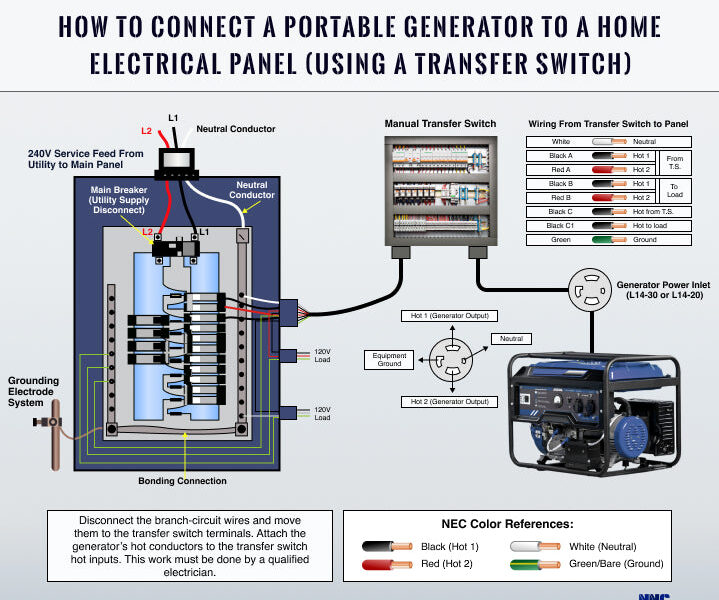
Whole-home backup usually requires a larger multi-battery system, often paired with a hybrid inverter integrated into your electrical panel. That’s a bigger project than buying a single portable unit. [6]
The Bottom Line
Choose a portable power station if your backup needs are limited to a refrigerator, lighting, a router, and charging devices, and if you’re comfortable with short outages or have solar recharging available. It’s quieter, indoor-safe, and emits no carbon monoxide. [1][2]
Choose a gas generator if you need to run central HVAC, an electric water heater, a well pump, or other large loads, or if you regularly face outages longer than two to three days without a way to recharge batteries. It will provide higher continuous power and can run as long as fuel is available. [1][5]
If you’re resilience-focused and have space for panels, a hybrid solar-plus-battery setup can extend runtime indefinitely in sunny conditions and reduce grid dependence, but it costs more upfront and requires roof or yard space. [6]
Before you commit, verify the current specifications, pricing, and package contents on the manufacturer or retailer listing. The right answer depends on your square footage, your critical loads, and how long your area tends to lose power.
Sources
[1] Portable Power Station vs Gas Generator — https://poweroutage.us/generators/portable-power-station-vs-generator [2] Best Portable Power Stations — Consumer Reports — https://www.consumerreports.org/home-garden/generators/best-portable-power-stations-a4748703075 [3] When To Use a Portable Power Station vs. Generator — https://ussolarsupplier.com/blogs/news/when-to-use-a-portable-power-station-vs-generator [4] Portable Power Station vs Generator — Oukitel Power — https://oukitelpower.com/blogs/blog/portable-power-station-vs-generator [5] Is a Portable Power Station Better Than a Generator? — BLUETTI CA — https://www.bluettipower.ca/blogs/buying-guide/is-portable-power-station-better-than-generator [6] Best Portable Power Station For Home Backup 2025 — https://oupes.com/a/blog/post/best-portable-power-station-for-home-backup-2025
This Post Has 3 Comments